Yi Jiao, Ming Li, Ping He, Ye Tao, and Yu-Hui Dong, HEPS Project Team, Institute of High Energy Physics, Chinese Academy of Sciences.
The High Energy Photon Source (HEPS) is the first fourth-generation synchrotron radiation light source project in China, and also the first green-field synchrotron radiation light source project in the high-energy region around the world. The adoption of the compact MBA design is indeed a pivotal advancement that has enabled the generational leap from third-generation to fourth-generation synchrotron radiation light sources, such as the HEPS in China and other facilities worldwide. By increasing the number of bending magnets (dipoles) in the storage ring and employing strong transverse focusing, the MBA design is feasible to reduce the natural emittance by one to two orders of magnitude, while keeping the circumference and budget comparable to those of third-generation light sources. This brings the emittance close to or at the diffraction limit for X-rays of interest. Furthermore, the fourth-generation light sources keep a beam current similar to third-generation light sources and utilize state-of-the-art insertion device (ID) technology, thereby increasing brightness by 2-3 orders of magnitude. Therefore, the fourth-generation machines provide new opportunities for frontier research in materials science, energy and environmental science, biomedicine, and other fields.
The HEPS in China is a flagship fourth-generation synchrotron radiation facility, designed with cutting-edge parameters (electron energy of 6 GeV, beam current of 200 mA, and natural emittance of 35 pm·rad) to deliver world-class performance. It is able to accommodate no fewer than 90 high-performance beamlines (with 15 beamlines for Phase I). The HEPS can provide X-rays with energies up to 300 keV, delivering synchrotron radiation with brightness of up to 1×10²² phs/(s·mm²·mrad²·0.1%BW) at a typical hard X-ray wavelength. It will feature spatial resolution on the order of 10 nanometers, energy resolution on the order of 1 meV, and temporal resolution on the order of 100 pico-seconds.
After more than ten years of R&D, including the HEPS test facility project (2016-2018), the HEPS project started construction in mid-2019. The main civil construction was essentially completed in 2022, and tunnel installation of the first equipment, the electron gun, started in the same year. In 2023, the HEPS team successfully completed commissioning of the HEPS linac and booster, ensuring the capability of the injector to provide high-charge bunches of up to 5 nC, which laid a solid foundation for the commissioning of the HEPS storage ring.
After about two years of hardware fabrication, laboratory testing, tunnel installation, and joint-debugging, the HEPS storage ring commissioning was initiated on July 23, 2024. Since then, much advancement has been achieved.
The Commissioning of the HEPS Accelerator
The first-turns commissioning was the first great challenge faced by the HEPS commissioning team, due to strong error effects and the small aperture inherent in the ultralow emittance design as well as possible unexpected difficulties that are commonly experienced in a green-field machine, like opposite polarity of magnets and an obstacle along the path of the injected beam. However, it took less than one month to achieve the first beam storage and beam accumulation with a current exceeding 10 mA. The first-turn circulation was achieved within one day, followed with more than ten-turn circulation about one week later. With RF cavities and multipoles turned on and compressive adjustment of all possible parameters, the first beam storage was achieved on August 6 with 40 μA current and an approximate lifetime of one minute. On August 18, the stored beam was increased to 12 mA, which indicated the storage ring was in good condition and ready for further fine optimization. In the following months, extensive efforts were made to improve the machine’s performance and beam quality.
In the subsequent commissioning, the stored beam current was increased to about 40 mA in September 2024, where a bottleneck was met; the step of increasing beam current was hindered by the RF voltage and power from the temporary RF system being used. This bottleneck was broken through with full installation of the RF cavities in May to July of 2025. The beam current is now being increased towards 100 mA and even higher current.
Furthermore, the novel injection scheme for the HEPS, i.e., an on-axis swap-out injection scheme with high-energy accumulation in the booster, has been validated. When the electron bunch in the storage ring has a certain loss in the bunch charge, the used bunches are extracted and injected to the booster, merged with fresh bunches in the booster at 6 GeV to restore the bunch charge, and then re-injected into the storage ring. In the injection commissioning, the key is to realize synchronization of ultrafast kicker pulses (10-ns width) with beam at 0.1-ns precision, by finely tuning the timing delays for the injection or extraction kicker pulsers. Now this scheme has been implemented in operation and commissioning. Future work is to achieve storage of 14.4-nC electron bunches through delicate injection efficiency optimization.
The Commissioning of the HEPS Beamlines
There are 15 beamlines in Phase I, including 14 user beamlines and 1 test beamline. Up to mid-2025, all beamlines, including one bending magnet beamline and fourteen insertion device beamlines, have started the commissioning phase. Light reached the endstations of all the beamlines, and a few pilot experiments have been performed, although commissioning time is very limited for most of the beamlines.
The first light of the HEPS from insertion device entered the endstation of the ID21 beamline on October 12, 2024. ID21 is a 350-m-long beamline for large field-of-view (FOV) X-ray phase contrast imaging with X-ray energy of more than 300 keV, tens of centimeters FOV, and high spatial resolution and high sensitivity.
There are 19 insertion devices installed in 15 beamlines. Six types of the 19 insertion devices were developed in-house, including a 12-m-period, 2-m cryogenic permanent undulator for a high-energy fundamental harmonic; an Apple-Knot undulator for a lower on-axis heat load needed by the nano-ARPES beamline; and a novel wiggler, called MANGO, for the large vertical spot size needed for large FOV phase-imaging. These insertion devices performed as expected during beamline commissioning. Synchronization between the undulator gap scan and the monochromator angle scan was realized. The crystal diagnostic instrument was installed in an optics enclosure to characterize undulator radiation, such as optical axis steering, phase error evaluation, and calibration of gap tapering with optical alignment.
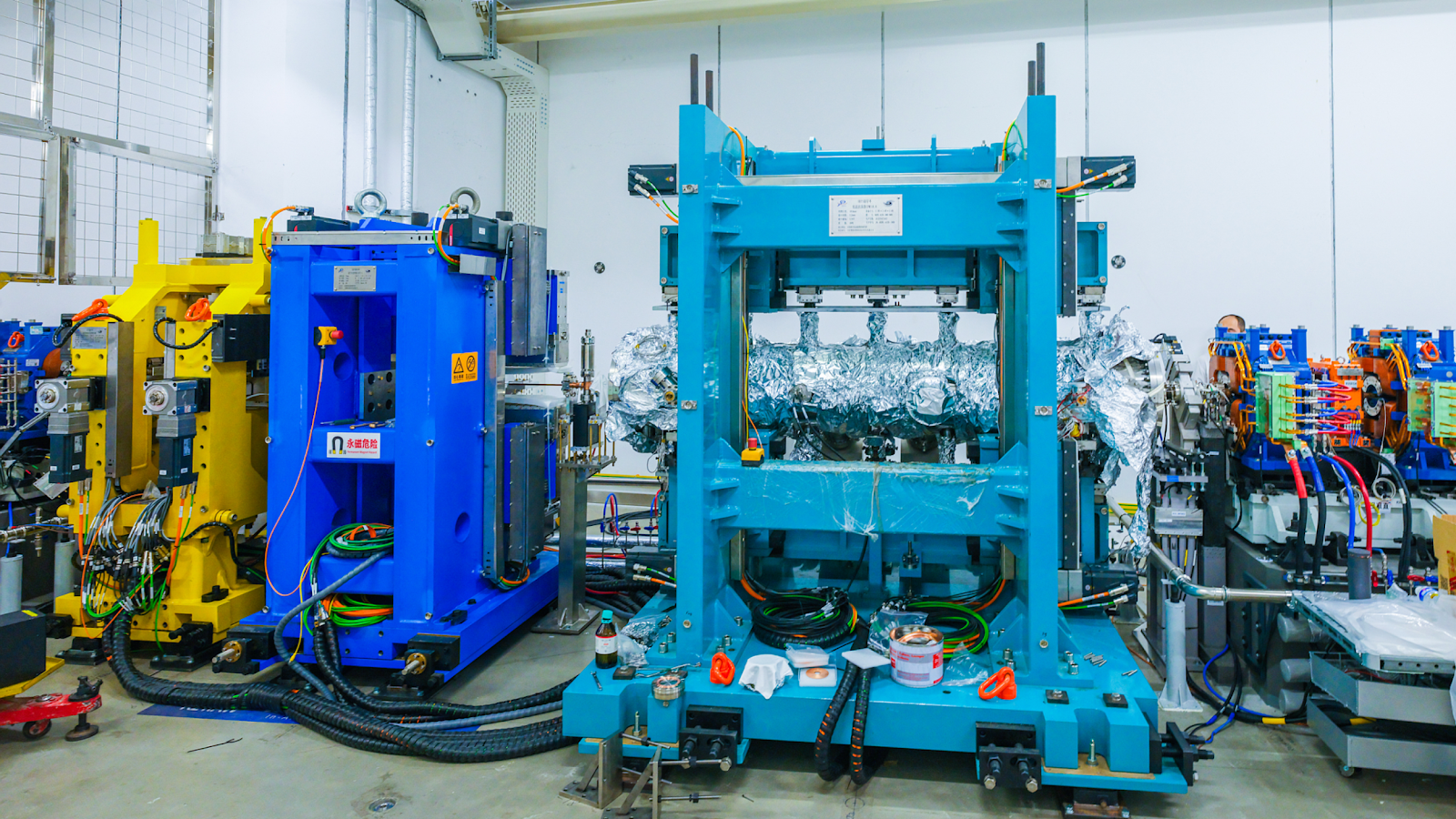
Three insertion devices installed in the ID21 phase-contrast imaging long beamline. Yellow: Mango wiggler, Blue: wiggler, Light Blue: CPMU.
Different wavefront measurement methods were utilized in nano-focusing commissioning. Along with the speckle and grating methods, we also developed the double-edge method; they all played a role in focusing tuning of the K-B mirror and Multilayer Laue lens. Besides beamline commissioning, a grating interferometer was built to measure the storage ring emittance. Installed in the coherent scattering beamline, it gave a result of 97 pm.rad, consistent with the result from the pinhole imaging method used by the accelerator division.
During commissioning, some pilot users were invited to test the beamline performance. We witnessed the power of this high-energy, fourth-generation source, even under less than 10-mA beam current, especially in phase contrast imaging for defect detection in engineering materials, and high-speed imaging and diffraction capability for dynamics process detection of metal 3D printing. In the transmission X-ray microscopy beamline, by utilizing the low-emittance feature, the symmetrical redshift ring of monochromatic light was obtained and used as ring illumination for the X-ray objective zone plate. Preliminary ptychography and XPCS measurements were performed in the coherent scattering beamline.
Most key beamline and endstation instrumentations were developed in-house, such as the monochromator, mirror system, transfocator, beamline diagnostic system, nano-positioning system for CDI, and long SAXS tube. While most of the instrumentations met the commissioning requirement, many drawbacks were exposed for further optimization. In the meantime, Mamba, a developed experimental control and data acquisition system, was deployed in every beamline and put into commissioning. The test beamline played its role immediately after the monochromator light tuned out, helping to evaluate the different optics components and instrumentation, such as Laue bending crystal wavefront measurement, channel-cut crystal quality evaluation, CRL error assessment by the speckle method, and CRL alignment validation in the transfocator.
HEPS successfully met its performance-acceptance criteria in October of this year. The HEPS will be open to global academic and industrial users gradually beginning in early 2026. Updates on the HEPS can be found at heps.ihep.ac.cn.