Eric Prebys, UC Davis

The North American Particle Accelerator Conference (NAPAC-25) took place from August 10th to August 15th at the SAFE Credit Union Convention Center in Sacramento, California. The event was hosted by the University of California Davis, SLAC National Laboratory, Lawrence Berkeley National Laboratory, and Lawrence Livermore National Laboratory, sponsored by the IEEE and APS. It drew roughly 420 attendees as well 19 industrial vendors and other exhibitors.
The conference included invited and contributed talks, daily poster sessions, and tutorials, as well numerous special sessions and satellite meetings. It's impossible to summarize it in its entirety in a short newsletter, so we will do our best to cover some of the highlights.
Talks on current projects and facilities included updates from APS Upgrade commissioning at Argonne National Laboratory, attosecond X-ray production at the LCLS-II at SLAC National Laboratory, operation of the SuperKEKB collider at KEK, the commissioning of the High Energy Photon Source (HEPS) in China, and MegaWatt operation of the Fermilab Accelerator complex. Near term projects that were discussed included the LANSCE Modernization Project at Los Alamos National Laboratory, the CEBAF Energy Upgrade at Jefferson Laboratory, and of course several talks and presentations on the Electron-Ion Collider (EIC), which will be constructed at Brookhaven National Laboratory.
In the longer term, there were talks on the Future Circular Collider (FCC) at CERN, which was also discussed along with the EIC in a special evening session. Discussion of potential paths to a high energy electron-positron collider included both the traditional ILC and CLIC approaches, as well as recent advances in Cool Copper Cavities (CCC) and more speculative ideas involving Plasma Wakefield Acceleration (PWFA), which was also the subject of an invited talk. The renewed domestic interest in a Muon Collider. was evidenced by a number of posters and talks, including an invited oral presentation.
Topics involving Artificial Intelligence (AI) and Machine Learning (ML) were ubiquitous in talks and poster sessions. These included applications in beam dynamics simulation, design of accelerators and related technology, instrumentation and diagnostics, and accelerator control and operational optimization.
Many talks and posters covered diverse enabling technologies related to accelerators. Among other things, topics included normal and superconducting RF, intense sources, and compact linacs.
There were many talks about applications of accelerators and accelerator-related technology to other areas in medicine and industry. There were discussions of various techniques to generate short, intense proton pulses to be used for “flash” proton therapy. There were also interesting talks about how a number of technologies developed for accelerators are now being applied to quantum computing. There was a very interesting talk about Nusano, a start up company in Salt Lake City that is building a high current ion linac to produce a number of medical isotopes that are currently in short supply.
The conference included four in-depth tutorial sessions. The topics covered were high brightness electron injectors, generative deep learning for particle accelerators, harnessing nonlinearity in beam optics, and RF sources for accelerator applications.
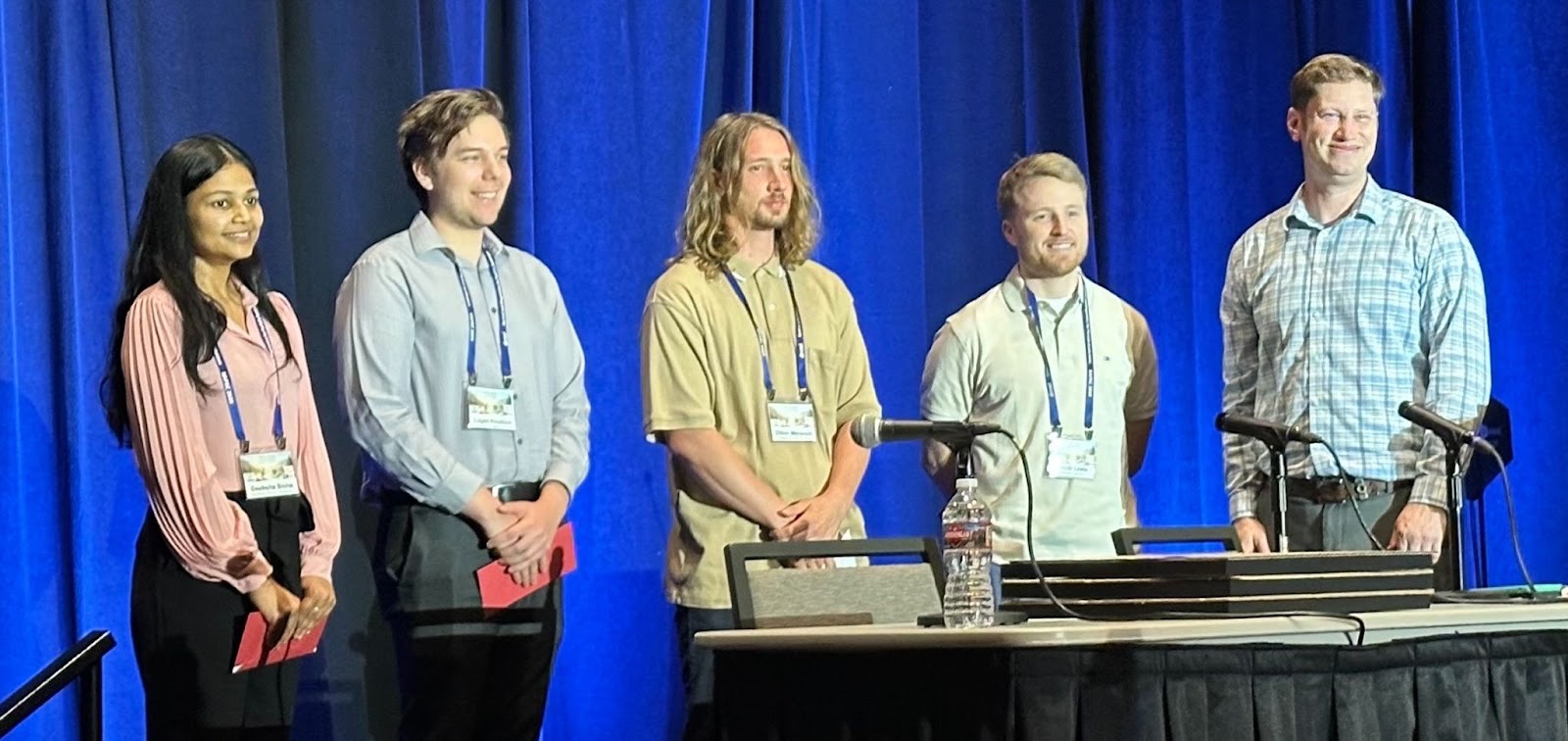
At the awards session, the IEEE Particle and Accelerator Science and Technology (PAST) Awards went to Jean Luc Vay of LBNL and Yoshinori Enomoto of KEK, while the Doctoral Student Award went to Andrew Fisher of Zap Energy (PhD from UCLA). The USPAS Prizes for Achievement in Accelerator Science and Technology went to Eric Esarey of Lawrence Berkeley National Lab, Sang-Ho Kim of Oak Ridge National Lab, and Sam Posen of Fermi National Accelerator Laboratory. The APS Outstanding Doctoral Thesis Research in Beam Physics Award went to Xiujie Deng of Tsingua University and the Robert R. Wilson Prize for Achievement in the Physics of Particle Accelerators went to Alexander Zholents of Argonne National Laboratory. Finally, Student Poster Awards went to Deeksha Sinha (Northern Illinois University), Logan Knudson (University of California Davis), Dillon Merenich (Northern Illinois University), and Jacob Lewis (Old Dominion University).
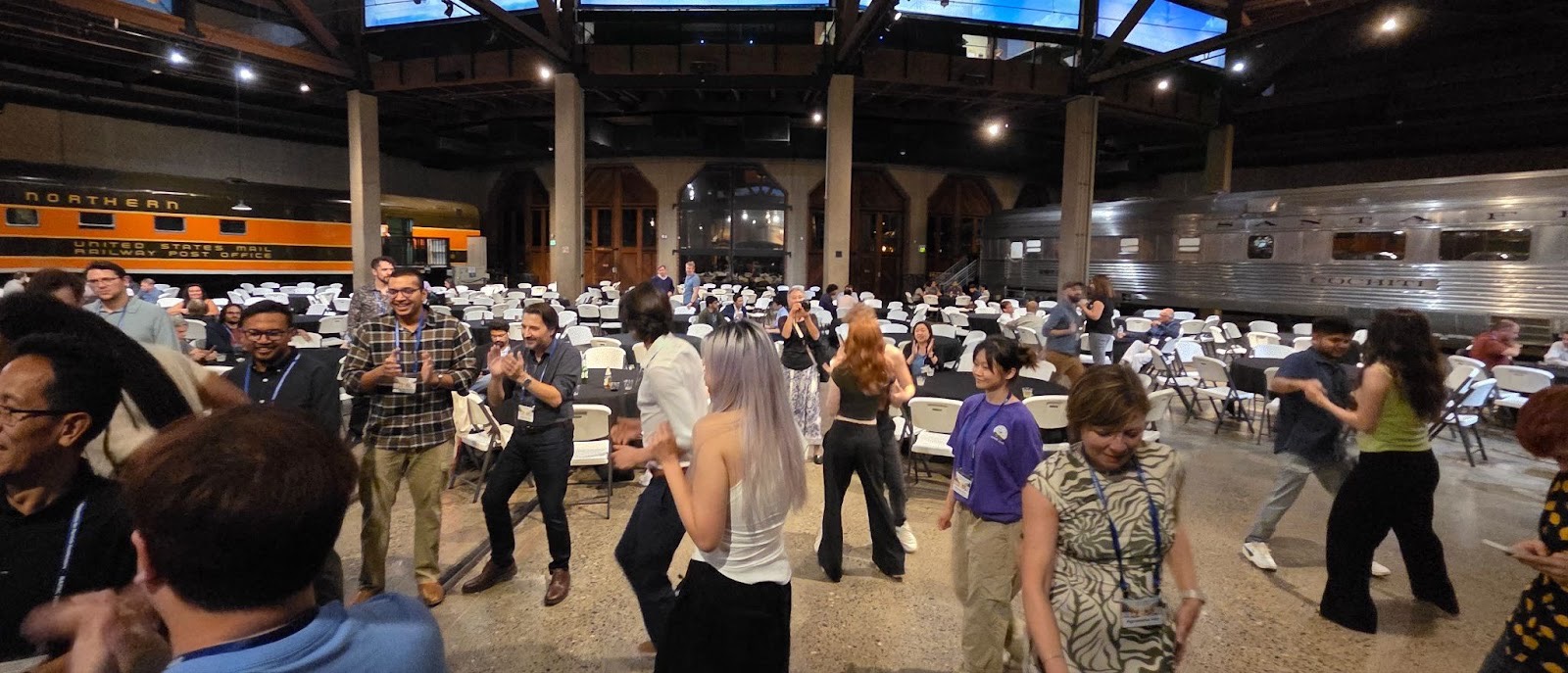
Social activities included a reception on Sunday and an early career networking session on Wednesday, which was very well attended. The conference banquet was held at the California Railroad Museum, in Old Town Sacramento. The attendees had the complete run of the museum, which seemed well suited to the crowd.