Wolfram Fischer, Brookhaven National Laboratory
Since its first collisions in 2000, the Relativistic Heavy Ion Collider (RHIC) [1] (Fig. 1) at Brookhaven National Laboratory has been a flagship international nuclear physics facility. As the world’s first collider designed specifically for heavy ions and the only one capable of colliding polarized protons [2,3], RHIC has pushed the boundaries of accelerator science, delivering transformative discoveries in quantum chromodynamics (QCD), while also pioneering a range of accelerator technologies.
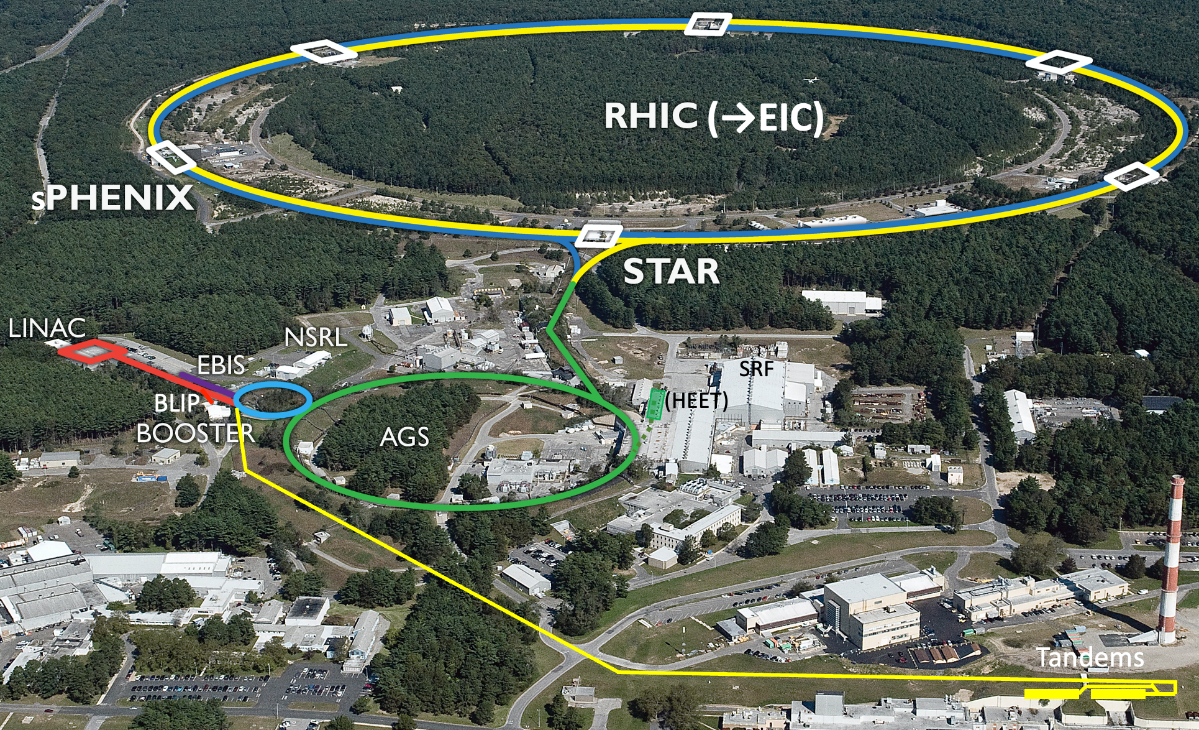
Figure 1: Aerial view of RHIC, its detectors, and injector complex in 2025.
Collider Versatility and Performance
RHIC consists of two superconducting rings with 3.5-T dipole fields, providing a maximum beam energy of 100 GeV/nucleon for Au beams, and 255 GeV for polarized protons. RHIC was designed for extraordinary versatility, and over its 25 years of operation, it has fulfilled and expanded upon that vision [4]:
-
RHIC has collided 12 ion species combinations and operated at 18 center-of-mass energies (Fig. 2). Species combinations range from polarized protons to gold and uranium and include asymmetric collisions of light with heavy ions, e.g., p+Al, p+Au, d+Au, and 3He+Au. The energy range extended below and slightly above the design energies.
-
A particularly interesting run took place in 2018 with alternating stores of Zr+Zr and Ru+Ru collisions at the same luminosity, held constant throughout the stores. The isotopes Zr-96 and Ru-96 had the same number of nucleons but charges of 40 and 44, respectively. Both isotopes have a low natural abundance of only a few percent, and it is challenging to make high-intensity sources. The Ru-96 source material was obtained from ORNL after a special enrichment run at the new Stable Isotope Production and Research Center [5].
-
Through machine upgrades and innovative techniques, notably stochastic cooling and bunch intensity increases, peak luminosities have increased significantly. For the benchmark heavy-ion species combination Au+Au, the average store luminosity reached Lavg = 87 × 1026 cm-2s-1, or 44× the design luminosity.
-
RHIC is the first polarized proton collider and the only facility capable of colliding polarized protons at high energies, enabling precise studies of the proton spin structure [2,3,6]. At the highest energy, the average stored luminosity reached Lavg = 160 × 1030 cm-2 s-1 with an average polarization of Pavg = 57%.
-
In most years, the machine availability (beam available as a fraction of scheduled time) exceeded the target of 80%.
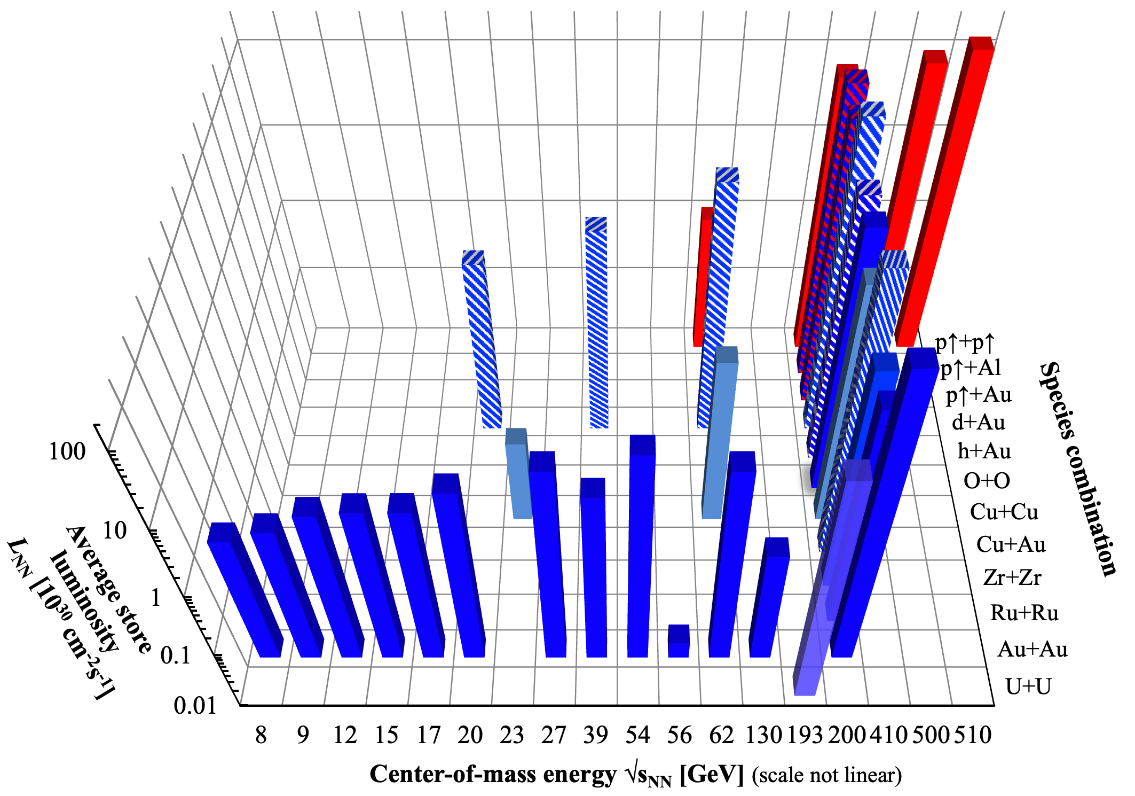
Figure 2: Average store luminosities for all species combinations and center-of-mass energies from 2000 to 2025. The nominal injection energy corresponds to a center-of-mass energy of 20 GeV.
Accelerator Innovations
RHIC has been a testbed for cutting-edge accelerator technologies:
-
RHIC and its application programs (see below) drove the development of some of the world's best particle sources that deliver high-intensity, high-brightness beams. These include a high-intensity H– magnetron source [7], the Optically Pumped Ion Source (OPPIS) for polarized protons [8], the laser ion source (LION) [9] for unparalleled flexibility in changing ion species within seconds, and the Electron Beam Ion Source (EBIS) [10], recently upgraded to provide polarized He-3 beams. In addition, LEReC (see below) and the EIC also drove the development of high-intensity unpolarized and polarized electron sources.
-
RHIC was the first hadron collider to have active beam cooling implemented. For heavy ions, 3-dimensional stochastic cooling [11] was the key technology to increase the luminosity of the benchmark species combination Au+Au to 44× the design value. Stochastic cooling allowed RHIC to operate close to the burn-off limit, when almost all beam losses are due to collisions with the other beam.
-
At energies below the design injection energy, RHIC implemented for the first time bunched beam electron cooling with the Low Energy RHIC electron Cooling (LEReC) upgrade [12]. The resulting luminosity increase supported a physics program to search for the location of a critical point in the nuclear matter phase diagram. Previously, all electron coolers were based on electrostatic acceleration, which provided excellent beam quality but had limited energy reach. LEReC's RF-accelerated approach expanded that reach and will now be used in the Electron-Ion Collider (EIC).
-
RHIC demonstrated compensation of the head-on beam-beam effect in p+p collisions using electron lenses [13].
-
For polarized proton operation, RHIC developed and implemented superconducting helical dipole magnets ("snakes") that preserve spin polarization through acceleration and storage—a key technology that enabled exploration of the proton's spin structure.
Broader Impacts
Beyond RHIC operation, the hadron injectors also serve application programs simultaneously. The electrostatic Tandem accelerators [14] also support industrial and academic users. The 200-MeV H– Linac delivers beam to the Brookhaven Linac Isotope Producer (BLIP) for medical and industrial isotope production [15]. The Booster supplies beam to the NASA Space Radiation Laboratory (NSRL) [16], which studies the effects of space radiation on biology and electronics. NSRL's Galactic Cosmic Ray Simulator [17] delivers up to 33 different beams (7 species at multiple energies) in 75 minutes, made possible by the flexibility of the laser ion source and EBIS.
RHIC has also trained and retained a highly skilled workforce across all aspects of accelerator development and operation. The machine and experiments have hosted and mentored hundreds of students, postdocs, and accelerator scientists, making RHIC a cornerstone of U.S. accelerator and nuclear physics workforce development.
Summary and Outlook
Over 25 years of operation, RHIC has set benchmarks in collider performance, technical innovation, and scientific versatility. It serves as a model for how a major accelerator facility can continue to innovate over its lifetime, driven by an evolving scientific mission, while supporting both fundamental science and broader societal applications. Its legacy will carry forward into the Electron-Ion Collider (EIC) [18], which will reuse one of RHIC’s superconducting rings, along with much of its infrastructure and injector chain.
References
[1] M. Harrison, T. Ludlam, S. Ozaki, "RHIC project overview”, Nucl. Instrum. Meth. A 499, 235-244 (2003).
[2] T. Roser (spokesperson), W.W. MacKay (project manager) et al., "Configuration manual, polarized proton collider at RHIC)”, BNL-97226-2012-TECH, C-A/AP 455; BNL-97226-2006-IR (2006).
[3] E.-C. Aschenauer et al., "The RHIC SPIN program: achievements and future opportunities", (2015), arXiv:1501.01220
[4] Overview of all RHIC Runs 2000-2025, \\https://www.rhichome.bnl.gov/RHIC/Runs/
[5] ORNL Stable Isotope Production and Research Center (SIPRC), https://www.ornl.gov/content/stable-isotope-production-and-research-center
[6] M. Bai et al., "Polarized proton collisions at 205 GeV at RHIC", Phys. Rev. Lett. 96, 174801 (2006).
[7] D. Raparia, J. Alessi, G. Atoian, and A. Zelenski, "Charge neutralized low energy beam transport at Brookhaven 200 MeV linac", Rev. Sci. Instrum. 87, 02B935 (2016).
[8] A. Zelenski et al., “Optically pumped polarized H– ion source for RHIC spin physics,” Rev. Sci. Instrum. 73, 888–891 (2002).
[9] K. Takahashi, M. Okamura, T. Kanesue, S. Ikeda, K. Kondo, M. Sekine and T. Karino, "Performance of laser ion source LION operated at Brookhaven National Laboratory", Journal of Physics: Conference Series 2743, 012096 (2024).
[10] J.G. Alessi et al., "The Brookhaven National Laboratory electron beam ion source for RHIC", Rev. Sci. Instrum. 81, 02A509 (2010).
[11] M. Blaskiewicz, J. M. Brennan, and K. Mernick, “Three-Dimensional Stochastic Cooling in the Relativistic Heavy Ion Collider”, Phys. Rev. Lett. 105, 094801 (2010).
[12] A.V. Fedotov et al., "Experimental demonstration of hadron beam cooling using radio-frequency accelerated electron bunches", Phys. Rev. Lett. 124, 084801 (2020).
[13] W. Fischer et al., "Operational head-on beam-beam compensation with electron lenses in the Relativistic Heavy Ion Collider", Phys. Rev. Lett. 115, 264801 (2015).
[14] BNL Tandem Van de Graaff facility, https://www.bnl.gov/tandem/
[15] BNL Brookhaven Linac Isotope Producer (BLIP), https://www.bnl.gov/mirp/blip.php
[16] K. Brown et al., "The NASA Space Radiation Laboratory at Brookhaven National Laboratory: preparation and delivery of ion beams for space radiation research", NIM A 618(1-3), 97-107 (2010).
[17] J.L. Huff et al., "Galactic cosmic ray simulation at the NASA Space Radiation Laboratory - progress, challenges and recommendations on mixed-field effects", Life Sciences in Space Research 36, 90-104 (2023).
[18] Electron-Ion Collider (EIC), https://www.bnl.gov/eic/, https://www.jlab.org/eic