Sang-ho Kim, Nicholas Evans, and John Galambos, Oak Ridge National Laboratory
The Spallation Neutron Source (SNS) at Oak Ridge National Laboratory (ORNL), one of the most powerful scientific tools of its kind in the world, is undergoing a major transformation (Fig. 1). This powerful scientific facility helps researchers to study the building blocks of materials, understand how things behave at the atomic level, and develop new technologies in chemistry, biology, materials science, advanced manufacturing, and medicine. To keep up with growing scientific demand and explore even deeper into the unknown, the SNS began a new journey. The recently completed Proton Power Upgrade (PPU) project doubles the beam power capability from 1.4 to 2.8 MW with the potential for even more power in the future.
Why does this matter? At the SNS, protons are accelerated to nearly the speed of light and smashed into a liquid mercury target. When high-energy protons strike mercury nuclei, neutrons are liberated through a process known as ‘spallation’. These neutrons are slowed down and used to examine materials through neutron scattering. Increasing beam power means that more neutrons can be produced, giving scientists at the 20 neutron instruments clearer images, faster results, and the ability to study materials that were previously too complex or delicate to examine. This upgrade is essential for the future of neutron scattering in the U.S. A new 700-kW experimental station, called the Second Target Station, is being planned to expand the SNS instrument portfolio and scientific footprint. But for both target stations to run effectively, more beam power is essential. With the increased capability, SNS will be able to serve more researchers, support more experiments, and continue delivering groundbreaking scientific discoveries.
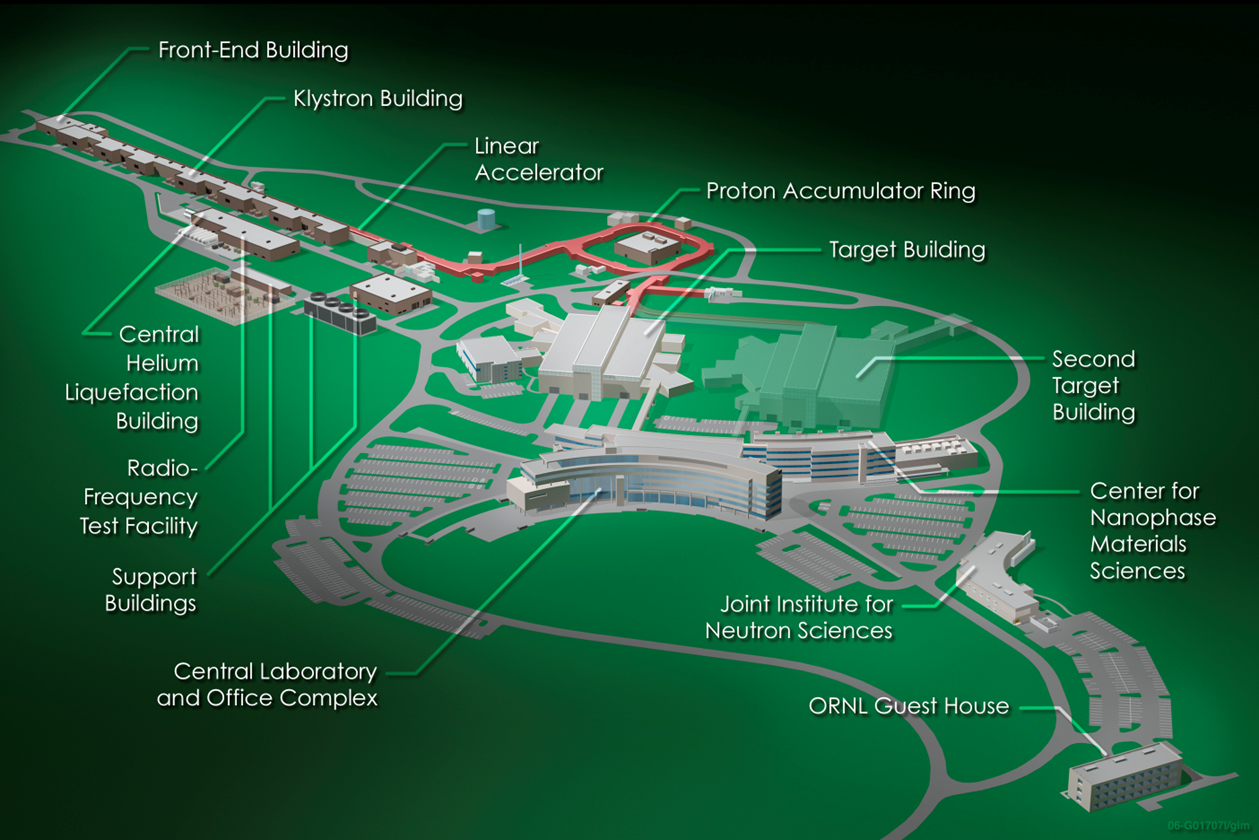
Figure 1: Layout of the SNS at Oak Ridge National Laboratory.
The PPU project doubled the beam power capability by increasing beam energy from 1.0 GeV to 1.3 GeV and by increasing beam current by 50%. The 1.3-GeV beam energy is close to the built-in upper limit due to Lorentz stripping in the high energy beam transport (HEBT) arc between the linac and the accumulator ring. The high-level goal of the PPU project for the accelerator is to extend the linac to reach a world-record 1.3 GeV and replace and upgrade components not capable of 2.8-MW beam operation. The PPU project has completed the installation and testing of all project scopes required to meet key performance parameters (KPPs), supported beam commissioning in June 2024, and transitioned to operations in July 2024. Seven new cryomodules were installed to reach 1.3 GeV along with supporting radiofrequency (RF) systems, the injection and extraction regions in the accumulator ring were upgraded to transport 1.3-GeV beam, a 2-MW mercury target was developed, and ancillary target systems were upgraded.
Beam commissioning is a critical phase in any accelerator project, involving the careful integration and testing of all major systems that guide and accelerate the proton beam. Thanks to extensive planning, detailed simulations, an excellent operational foundation developed over years, and staff expertise, beam commissioning of the PPU project proceeded very smoothly and completed successfully, marking a major milestone for the facility. For the PPU project, this included validating the performance of newly installed superconducting linac sections, RF systems, control systems, accumulator ring, and target systems. During commissioning, the 1.3-GeV, 1.7-MW equivalent beam at the target showed excellent alignment, low beam loss, and reliable operation. As of today, two neutron-production run cycles were completed after the PPU final installation. The recent run cycle at 1.8-MW beam power was completed in May 2025 with high availability for the user program. Figure 2 contains snapshots taken from the public SNS website, showing SNS beam power history since the SNS started its operation in 2007 and availability of the SNS machine during the previous run cycle running at 1.8-MW beam power. For a good portion of the previous run cycle, the SNS machine was running stably with > 95% availability.
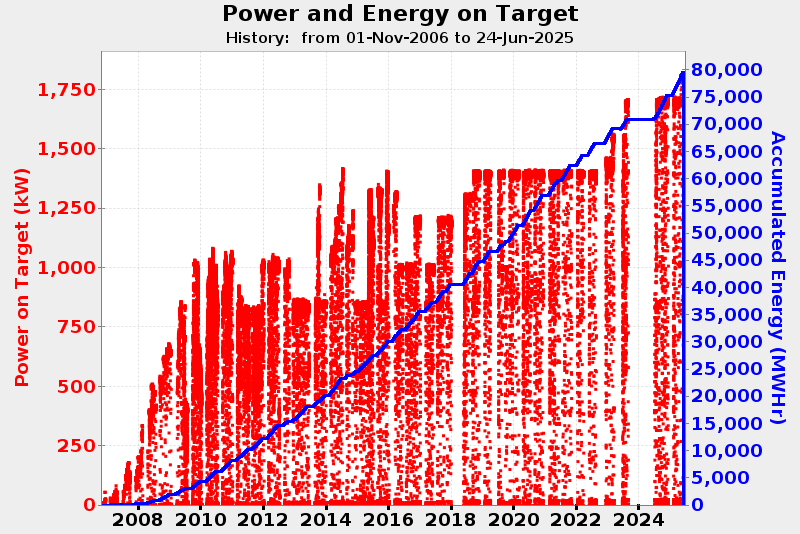
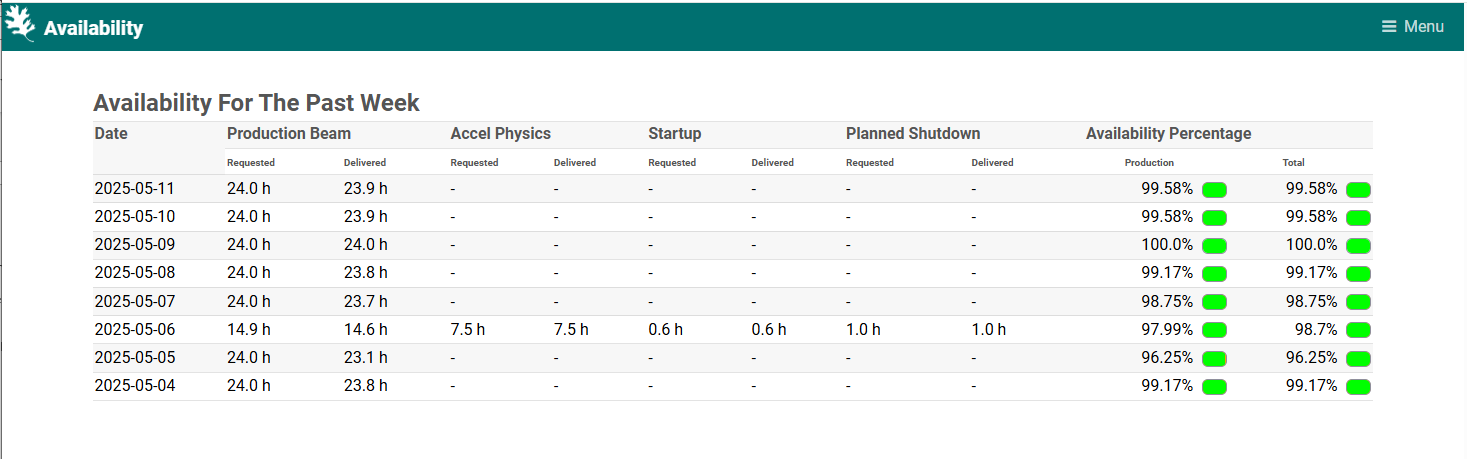
Figure 2: SNS operation data from the public SNS website, https://status.sns.ornl.gov/. (top) SNS beam power history since 2007, (bottom) a snapshot of the SNS machine availability during the FY2025 run cycle.
Over the next few run cycles, the proton beam power on the first target station will be increased in 100-kW steps until it reaches 2-MW beam power on the first target station. It is important to point out that each step of power ramp-up is similar to the entire machine beam power of facilities elsewhere.
Reaching a new level of beam power is not as simple as turning a dial. Let us look back at the experience of achieving the design beam power for the original SNS project. Since this beam power was almost an order of magnitude higher than previous accelerator-based neutron facilities, all subsystems of the SNS were designed and developed for substantial improvements over existing accelerators. Some subsystems were first-of-a-kind, such as the highest-energy hadron linear accelerator, the first use of superconducting RF (SRF) technology for a high-power proton linac, the highest proton beam intensity in the ring, the first liquid mercury target, etc. Pushing the envelope in so many ways introduced unknown and unpredictable performance, and reliability issues. It took time to understand the systems as a whole and to determine the need for additional performance improvements. The SNS reached a stable operation at the design beam power of 1.4 MW in 2019, as shown in Fig. 2.
Learning from the history of SNS, we know that the move toward 2.8 MW is not just about scaling up power, but also about entry into unexplored territory in terms of beam power, system integration, and reliability. Building and operating a machine that can handle such power is a serious beam physics and technology challenge. Every part of the system must work together with incredible precision. As the beam power increases, it becomes even more important to control the proton beam dynamics because even a tiny amount of beam loss can damage equipment or make maintenance more difficult. The target system, where the beam produces neutrons, also faces new challenges. Higher power means the mercury target gets hit harder, creating intense shock waves and more mechanical fatigue. Though injecting helium gas bubbles into the mercury softens these impacts, its lifetime at this power level is not predictable. On top of the challenges associated with reaching high power, we must keep the machine running reliably and safely. When components get hotter, more stressed, and more radioactive, it becomes more important than ever to catch problems early and fix them in advance. To address these challenges, SNS launched the ‘2.8-MW initiative’ right after completion of the PPU project.
The 2.8-MW initiative aims to proactively identify potential weak links and uncover unknown unknowns as early as possible to minimize risks during high-power operation. It emphasizes the importance of performing advanced stress testing wherever possible to validate system performance and uncover vulnerabilities. A key objective is to ensure sufficient operational margins including equipment capacity, beam energy, beam current, beam loss, and other parameters to maintain high reliability and support long-term sustainability. We also acknowledge that the ring performance at this beam intensity level remains largely uncharted, and dedicated efforts are needed. Additionally, it focuses on training and preparing staff to operate and maintain the facility reliably as it moves into a higher power regime. The culmination of the 2.8-MW initiative is a demonstration of the SNS operating the first target station consistent with plans for the second target station era, with 2-MW beam power on the first target station at 45 pulses per second in a few years.
Looking further ahead, this effort sets the stage for the next generation of high-power particle accelerators. Around the world, other major science projects are being designed to run at even higher power levels — for example, to study the mysteries of neutrinos, to drive the future muon collider, or to find better ways to manage nuclear spent fuels. The knowledge and experience gained at SNS will help guide these future efforts, placing the United States in a leading position in accelerator-based science and technology.
In the end, the SNS power ramp-up is more than just accelerator science and technology. It is about giving scientists the tools they need to ask bigger questions and find better answers. It is about supporting breakthroughs that can lead to the next generation of high-power accelerators. And it is about staying at the forefront of global research for decades to come. By reaching 2.8 megawatts and going beyond, SNS is powering up for the future of discovery.