Laurent Chapon, Jonathan Lang, Vadim Sajaev. Advanced Photon Source, Argonne National Laboratory, Lemont, Illinois, USA
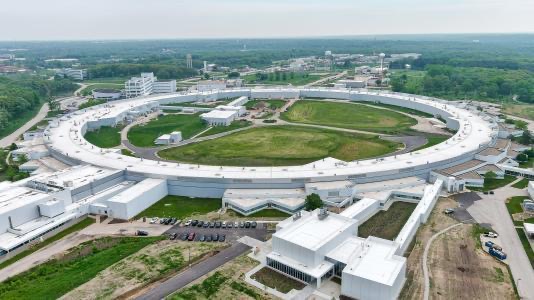
Arial view of the APS, showing new building for two new long beamlines extending beyond the APS experimental floor (ISN & HEXM) in the foreground.
Over the past 50 years, synchrotron x-ray light sources have been extremely successful tools for understanding the atomic-scale structure, elemental make up, dynamics, charge state, etc. of matter for research in areas such as physics, chemistry, materials science, geo-sciences, and biology. Currently there are approximately 50 synchrotron facilities world-wide that together host ~60,000 unique researchers each year exploiting the unique x-ray capabilities provided by these sources to address the most pressing societal problems. Successive generations of these facilities have continued to push the technological frontiers to provide x-ray beams with ever higher brightnesses (intensity per unit spatial and angular area), resulting in measurements of increasing fidelity and making techniques that exploit the coherence of the beam possible. Enabling such technological transitions is complex, involving multiple actors that push different facets of the technology to maturity. For large-scale scientific instrumentation, such as synchrotron facilities, these transitions require ingenuity, the perseverance of experts in the pursuit of technological improvements, consultations with a wide range of stakeholders, the exchange of knowledge across large communities and validations of new concepts that sometimes extend over multiple decades. The synchrotron light source community is currently undergoing the latest of such transitions, with storage ring x-ray facilities worldwide entering, in turn, the 4th-generation source era. Among them, the Advanced Photon Source (APS) at Argonne National Laboratory is leading the pack with one of the most advanced technological innovations pushing the limits of electron beam emittance to unprecedented levels [1] and increasing x-ray brightness by a factor of 500 compared to that available at the original 3rd-generation facility. With these latest increases, the overall gains in brightness since the original 1st-generation synchrotron sources operated parasitically on high-energy physics machines is now approaching twelve orders of magnitude, completely transforming the potential synchrotron experiments first envisioned.
Decreasing emittance in particle accelerators while maintaining beam stability has been a perpetual quest, whether to increase luminosity for colliders or to increase X-ray brightness for “scattering” facilities. For X-ray synchrotron facilities, the work of Chasman and Green at Brookhaven National Laboratory in 1975 [2] was foundational. It provided at the time an order of magnitude reduction in emittance compared to previous 2nd-generation rings and became the baseline for nearly all 3rd-generation machines built from 1990 to the 2010s, including the APS. As the APS started operation in 1995, the community was already imagining the future with a natural extension of the original double-bend achromat lattice to a multi-bend achromat (MBA) [3] capable of reaching sub-nanometer emittance. It took more than two decades and the pioneering work at Max-IV in Sweden to make this lattice a physical reality [4], reaching 330pm and becoming the first operational 4th-generation storage ring in the world in 2015. Greenfield projects such as Sirius, in Brazil, have pushed the limit further since then (250pm), but many of the new facilities coming online now are upgrades of existing facilities, for which the reuse of a large fraction of the existing infrastructure offers a significant benefit. Making these upgrades a reality, i.e., accommodating the existing source point constraints without compromising performance, required another breakthrough, which came from the European Synchrotron Radiation Facility (ESRF) in Grenoble, France. By modifying the MBA lattice and introducing dispersion bumps, the team at the ESRF engineered a hybrid-lattice [5] with acceptable magnetic field strengths and gradients, which reduced the emittance further to 139pm. The APS design was inspired by the ESRF-EBS (Extremely Brilliant Source) HMBA design with two significant additional innovations: introducing so-called reverse bends that lower the emittance further [6] and introducing a wholly new on-axis injection scheme to replace electron bunches in a ring with a very small dynamic aperture [7]. These innovations decreased the nominal horizontal emittance to 42pm, which has been achieved and exceeded using round beams (31(2) pm) [1], making APS the first facility breaching the 100-pm limit, and realizing an emittance ~16 times lower than what was originally conceptualized in 1995. For the Advanced Photon Source and its user community, it now means that a beam at 30-keV photon energy has the same flux as that provided at the original facility but with a source size ten times smaller (13 microns) and a divergence ~5 times smaller (<6 microrad) in the horizontal direction.
To ensure that the upgrade of the APS maximizes the potential for new discovery and to continue providing world-leading scientific output, the Department of Energy (DOE) implemented a comprehensive upgrade of the facility. The APS-U project is an $815M project sponsored by the Office of Basic Energy Sciences (BES) in the Office of Science of DOE. It includes, in addition to the new storage ring, nine feature beamlines offering entirely new scientific capabilities and 15 additional upgrades of existing beamlines to boost performance of extended capabilities. The project has been in the making for more than a decade and received authorization to start construction in 2020. Despite significant challenges due to supply-chain disruptions in the period 2020-2022, and significant inflationary pressures, the project has achieved all its key performance parameters and is on track to complete the project on time and within the original budget envelope. The shutdown of the facility between April 2023 and April 2024 to replace the storage ring and associated equipment was executed within the planned 1-year shutdown. While the commissioning of the new accelerator started slightly later than planned, an extremely efficient machine commissioning period was able to deliver first light onto a beamline in less than 3 months, and reached the nominal 200-mA full operational current in less than 9 months, ahead of schedule. For fiscal year 2025, the APS is on track to provide the full 5000 annual beam hours to the user community (albeit with less than the full suite of beamlines in operation due to the sequential ramp-up), with a machine uptime exceeding 96%, a remarkable achievement given the nature of the upgrade and a cutting-edge injection method used for the first time in the world.
While the new storage ring is the heart of the upgraded facility, the beamlines that utilize the emitted x-rays are the engines that empower novel scientific discovery. The APS already had a large suite of beamlines in place that could resume their respective scientific programs relatively quickly after recommissioning their optics and instrumentation with the new source. The first beamline to receive x-rays after the upgrade was the 27-ID Resonant Inelastic X-ray Scattering (RIXS) beamline on June 16th, 2024, and a year later 62 of the possible 72 beamlines have taken x-rays with most already hosting user experiments that are leveraging the greatly enhanced source properties. Since the APS was a relatively mature facility with few locations for new instruments, the total number of beamlines post-upgrade is only slightly above that which existed prior to the upgrade (72 vs. 68).
Of the APS’s 72 beamlines, nine are new or completely rebuilt beamlines constructed as part of the APS upgrade project. While all beamlines benefit from the brightness improvements, the project beamlines were specifically chosen to maximally leverage the extreme brightness of the new APS source to address new research questions that were previously impossible to explore due to limitations in beam brightness, coherence, or sample environment capabilities. The greatly increased beam coherence, for example, enables the study of dynamics of evolving systems on time scales that are orders of magnitude shorter than previously attainable (<microseconds to seconds). This is now being exploited by the X-ray Photon Correlation Spectroscopy (XPCS) beamline to understand the evolution of glasses, ferroelectrics, colloids, polymers, and other complex systems under various external stimuli. Similarly, the Coherent High-Energy X-ray (CHEX) beamline is utilizing coherent beams to understand the dynamics of atomic-layer growth in processes such as MBE, MO-CVD, or PLD, for predictive parameter optimization. The increase in beam coherence also greatly improves lens-less imaging methods where the spatial-resolution material being interrogated is only limited by the x-ray wavelength and coherent flux on the sample. The PTYCHO beamline, for example, is designed to obtain overlapping chemical and structural maps at the highest spatial resolutions (<5 nm) to gain unprecedented insights into materials such as catalysts and cement, while the Polarization Modulated Spectroscopy (POLAR) beamline will apply lens-less imaging with circularly polarized x-rays to obtain 3-dimentional images of magnetic domains. The upgrade also provided the opportunity to construct two new APS beamlines that extended beyond the main APS experiment hall into a new external building to provide unique sample handling capabilities and/or additional flexibility for focusing the beam with advanced x-ray optics due to the extended distance to the experimental station. The In-situ Nanoprobe (ISN) is a 240-m-long beamline delivering a highly focused x-ray beam (< 30 nm) with a large working distance (>50 mm). This provides sufficient space around the sample for complex sample environments, enabling studies of battery cycling or catalytic reactions at the nanoscale and in situ. The High-Energy X-ray Microscope (HEXM) beamline combines the penetrating power of very high-energy x-rays (>50 keV) with fine focusing, enabling non-destructive thermo-mechanical testing of engineered systems such as turbine blades or 3D printed metal alloys. This beamline also houses a unique facility developed in partnership with DOE’s Office of Nuclear Energy for handling and preparing irradiated samples for x-ray studies targeting improving the performance and safety of materials used in nuclear reactors. Beyond the primary project beamlines, an additional 15 beamlines were enhanced with improved optics or instrumentation to better exploit the new source using DOE-BES project funding, while a number of additional upgrades were funded by other sponsors (e.g., NIH, NSF, DOE-NNSA, etc.) on the beamlines they operate at the APS.
A common denominator of all these new beamlines and upgrades is not just their technical sophistication in terms of source, optical delivery, and sample manipulation, but their emphasis on providing realistic conditions: high temperatures, high pressures, chemical reactivity, mechanical strain — all under active monitoring. This increased shift toward in-situ and in-operando experimentation enables observation of materials at the atomic and nanoscales as they function, evolve, and fail in real time. This real-time ability to explore a complex multi-parameter phase-space is fertile ground for application of AI to provide additional insights into the data and for materials discovery. The APS is already heavily leveraging high-performance computing (HPC) and AI for data analysis due to the greatly increased speed and volume of data being generated by the upgraded APS.
The success of the APS upgrade and similar success at other facilities (ESRF [5], and more recently at the Swiss Light Source [8]) show the remarkable value of these transformative upgrades. The experience accumulated during several decades at each facility, the transfer and diffusion of knowledge throughout the entire light source community, together with the improved reliability of modern equipment, not only provided the foundation for success, but they also allowed us to execute these transformations in record time and achieve optimum performance after a much shorter commissioning period than experienced at 3rd-generation synchrotron sources. With so many other upgrade projects or new facilities currently in the works, in the US or the rest of the world, the synchrotron light source community is entering a very exciting period. The next several decades will surely demonstrate the strong benefits to science and society that the research conducted at 4th-generation synchrotrons bring, supporting discovery across the spectrum of research from basic research to very applied problems. Realizing that these facilities are formidable providers of scientific data and, therefore, at the heart of the AI for science revolution, the future is extremely bright. Of course, the technology will continue to evolve rapidly. Some facilities are already working on designs for 5th-generation storage rings. After all, we are still far away from the quantum limit, so let’s continue to dream and bring the field forward!
References
[1] Xianbo Shi et al., “Measurements of Source Emittance and Beam Coherence Properties of the Upgraded APS”, J. Synchrotron Radiat. 32(5), 1152-1161 (2025).
[2] R. Chasman, G. K. Green, and E. M. Rowe, “Preliminary design of a dedicated synchrotron radiation facility”, IEEE Trans Nucl Sci. 22, 1765 (1975).
[3] D. Einfeld, J. Schaper, and M. Plesko, “Design of a Diffraction Limited Light Source (DIFL)”, in Proc. of Particle Accelerator Conference, Dallas, TX. USA, 1, 177 (1995).
[4] M. Eriksson, “The Multi-Bend Achromat Storage Rings”, AIP Conf. Proc. 1741, 020001 (2016).
[5] P. Raimondi et al., “The Extremely Brilliant Source storage ring of the European Synchrotron Radiation Facility”, Commun. Phys. 6, 82 (2023).
[6] A. Streun, “The anti-bend cell for ultralow emittance storage ring lattices”, Nucl. Instrum. Methods Phys. Res. A 737, 148 (2014).
[7] L. Emery and M. Borland, “Possible Long-Term Improvements to the Advanced Photon Source”, in Proc. PAC'03, Portland, Oregon, USA, May 2003, paper TOPA014, pp. 256-258.
[8] P. R. Willmott and H. Braun, “SLS 2.0–The Upgrade of the Swiss Light Source”, Synchrotron Radiat .News 37, 24 (2024).