January 2026 Newsletter

From the Editor

Oriol T Valls is a theoretical Condensed Matter physicist at the University of Minnesota

News items in this issue include the Forum election results and the Forum APS Fellowship award. 

This time we have also four articles, more than the usual number, all on timely topics.

And also we have one book review. 

This time we have something we have not had for a while: an editorial on the low turnout in APS elections. It is intended to eleicit response on this important topic. 

The contents of this newsletter are mostly reader driven. All topics related to Physics and Society are welcome, excluding only undiluted politics and anything containing invective, particularly of the ad hominem variety. Strong opinionated language is however quite acceptable. Manuscripts should be sent to me, in .docx format, except Book Reviews which should be sent directly to book reviews editor Quinn Campagna qcampagn@go.olemiss.edu. 

The contents are not peer reviewed (I do read them before acceptance of course) and opinions given are the author’s only, not necessarily mine, nor the Forum’s nor, a fortiori, the APS’s either. But subject to the mild restrictions mentioned above no pertinent subject needs to be avoided on the grounds that it might be controversial. On the contrary, controversy is welcome. 

Oriol T. Valls                                                                                                                                          

University of Minnesota                                                                                                                             
otvalls@umn.edu

Top

Democracy at APS

We report in this issue the results for the 2025 election of Forum officials and we congratulate the excellent slate and all who participated, the electors as well as the candidates.

There is one aspect of the elections, not just in this Forum but in the APS in general, which for years has given me, and also the members of the Forum executive committee cause for concern: participation in the elections remains low. This year we had more votes than last year, but this is because the number of forum members has increased. The percentage voting remains stubbornly at about 12%. This is actually quite good compared to other Forums.

The Executive Committee worked very hard to improve this number. Reminders were sent about October 28 to everyone, referring to the original election announcement with their individual logon link. About November 3 an additional reminder was sent just to those who hadn't voted yet, including a "click once" link version . And you can see from the plot below that those reminders produce more votes, with the November 3 "click once" version being more effective.

So, the popularity of the Forum continues to increase, as shown by the numbers who are signing up, but we do not have a satisfactory level of participation in the elections.

We also surveyed the people who voted and the overwhelming majority declared themselves either satisfied or very satisfied with the voting system. So this is not the problem.

In trying to investigate the situation, we found that to a very large extent it is a general problem at APS: the society continues to increase in membership, but participation in elections is disgracefully low. For divisions the percentage voting is nearly always below 20% . For the Society as a whole, it avarages about 12% in recent years.

This cannot be due to unhappiness with the society: after all it is not mandatory to belong. People who dislike it can simply stop paying their dues. But this does not happen: people keep joining. Why don't people then get involved with choosing the people who run the organization?

One technical problem with the elections is that voters do not find out the names of the candidates until it is time to vote. One clicks on the link and only then the names of the candidates are revealed, with some brief biographies and not very distinctive statements. Perhaps publicizing the names of the candidates well in advance would help people get to know who the candidates are and make some decisions in advance.

This should be investigated in a properly scientific way and so should be the nontechnical issues. One possibility is that members view the Society as an organization that a) publishes journals and b) organizes meetings. As long as those two things are done satisfactorily, people might not care who the officials are. And indeed journals are published by an organization which is largely autonomous and only lightly supervised by the elected officials, these elected officials being involved only very indirectly. As to meetings, they are largely organized by a huge slate of volunteers, again with a perception that the elected officials are involved only peripherally.

So one may argue that things are fine. I disagree. One thing the elected people do is issue and periodically revise, statements on important scientific issues in many cases with social and political implications, represented as the opinion of the Society. And the moral force of these opinions is drastically abridged if we cannot show that these opinions are backed by a great majority of physicists.

So, I would like to offer this newsletter as a venue for people who have opinions or ideas as to the importance of this question and how it could be fixed. Please write, either in article or Letter to the editor formats. As always, controversy is not to be shunned.

I am very grateful to Beverly Hartline for obtaining the relevant data from APS.

Top

News

Awards

2026 Joseph A. Burton Forum Award

Paul Woafo

University of Yaoundé I

For exceptional contributions to advancing and disseminating physics in Africa, including founding the Cameroon Physical Society, facilitating student research that benefits local communities, and organizing in Cameroon international conferences on solving real-life problems in developing countries.

2025 APS Fellowship recipients sponsored by our Forum:

Omololu Akin-Ojo

University of Ibadan

For enhancing the science ecosystem in Africa and global physics communities as the inaugural director of the East African Institute for Fundamental Research, a UNESCO center in Rwanda.

Michael Cooke

U.S. Department of Energy

For leadership in coordinating the U.S. particle physics community's efforts to create communications materials that inform the science-interested public and decision makers about the long-term vision for and impact of high-energy physics research.

Minn-Tsong Lin 

National Taiwan University

For leadership in the advancement of physical sciences in Taiwan, global partnerships, and science advocacy while performing exceptional foundational research into the interaction in low-dimensional or nano-scaled magnetic systems.

Breese Quinn

University of Mississippi

For tireless advocacy on behalf of the U.S. high energy physics community, including leadership in building support for physics funding through personal and community outreach to Congressional delegations and appropriations staff.

Zac Ward

Oak Ridge National Laboratory

For pioneering experimental materials physics approaches that directly connect fundamental research to critical societal challenges in energy, computing, and workforce development.

Herman B. White Jr.

Fermi National Accelerator Laboratory

For inspiring leadership and advocacy for physics, science education, and communication with policy makers, governments and the public, and for outstanding contributions to several areas of high energy physics.

Christopher Wiebe

University of Winnipeg

For pioneering work on the synthesis of new magnetic materials and for leadership in the promotion of science literacy, political engagement, and underrepresented groups.

Editor's note: 

I am I am also pleased to add that our Assistant Editor Laura Berzak Hopkins, Princeton Plasma Laboratory has been awarded an APS Fellowship by the Division of Plasma Physics.

Forum Election Results

We congratulate our newly elected officers:

Vice Chair: Michaael Benett

University of Colorado, Boulder

Secretary/Treasurer: Cherrill Spencer

SLAC (retired) reelected

Two Executive Committee Members-at-Large:

Encieh Erfani

Perimeter Institute for Theoretical Physics, Canada

Kayla Miller

STEM Kings & Queens

These officers will assume their duties on January 1, 2026.

Top

Seeking a New Moral Compass on Nuclear Weapons Aboard the Golden Rule

Dylan K. Spaulding, DSpaulding@ucs.org

In 2010, a derelict sailboat called the Golden Rule was hauled from the depths of Humboldt Bay, California, where it had sunk. Keen eyes recognized that this boat had a notable history as a catalyst for anti-nuclear activism and before long, a group called Veterans for Peace was overseeing its restoration. Its salvation was a prescient act because the boat’s story is not done being told.

I was fortunate to be invited aboard the boat on its recent return from San Francisco to Eureka as a crew member, following in the footsteps of its original crew, and reflecting on how its mission to raise awareness of the threat of nuclear weapons remains as relevant today as when the boat originally sailed. 

In 1958, a group of four Quaker pacifists purchased the Golden Rule and set out to place themselves in a US nuclear test zone which was then active at Eniwetok Atoll in the Marshall Islands. The crew was led by Albert Bigelow, a former WWII naval commander who would also later take part in the 1961 Mississippi Freedom Rides. 

At the time of the original voyage, the risks of above ground testing were entering public conversation. Prominent figures including Linus Pauling, Albert Schweitzer, Bertrand Russell and Albert Einstein were speaking out on the biological and existential risks of nuclear weapons and concern over the ubiquity of nuclear fallout was generating public fear. As Quakers, Bigelow and his crew felt a moral duty to intervene. 

They made it as far as Honolulu before the Atomic Energy Commission issued a hasty decree that banned navigation in the test area, resulting in their arrest and imprisonment. The Golden Rule never reached Eniwetok, but news of the crew’s plight did reach the mainland and helped spur a popular anti-nuclear protest movement – one that borrowed from the nonviolent action and protests that were then defining the Civil Rights movement. The legacy of the Golden Rule’s message would carry on long after the voyage. 

As we set out under the Golden Gate Bridge on a much less momentous voyage up the coast, we were surrounded by whales and seabirds. We turned north-west under a setting sun and watched the Point Reyes lighthouse illuminate to guide us by. Someone quipped that the Pacific ocean was living up to its name with unusually calm conditions. Amidst the rich sea life around us, it was hard to imagine some of the largest nuclear weapons in history vaporizing distant parts of this same ocean in complete and utter contradiction to the peaceful evening we were experiencing. What feels abstract today were immediate realities for Bigelow and his crew, which caused me to reflect on their motivation and what motivates people to action today when popular awareness of nuclear issues is weak, despite renewed emphasis on nuclear weapons production and deployment.


Although above ground and atmospheric testing did cease with the 1963 Partial Nuclear Test Ban Treaty, underground testing continued until the 1990’s when the Comprehensive Test Ban Treaty (CTBT) was adopted (but which the US has never ratified). India, Pakistan, and North Korea are the only nations to have tested since then. While nuclear testing may seem like an artifact of the past, some advisors to the current administration are advocating for its resumption, a move which has already generated bi-partisan opposition in Nevada, where any new tests would likely occur. Despite these new developments, most of the public remains unaware, indifferent, or perhaps overwhelmed by other existential crises that fill today’s headlines. 

Bigelow’s motivation to act against testing was personal. As a naval commander in WWII, he was aboard his ship in the Pacific when he learned of the bombing of Hiroshima. After becoming a Quaker, he would later host some of the ‘Hiroshima Maidens’ – young Japanese women left disfigured by the atomic bombing - in his home. The ‘maidens’ were brought to the US to undergo plastic surgery in an attempt to help them avoid the stigma then associated with being ‘hibakusha’ (a bombing survivor). While the program has been the subject of intense controversy, Bigelow credited the maidens’ lack of animosity toward Americans as influential in his feelings about America’s use of the atomic bomb. He resigned his naval commission one month before becoming eligible for his pension. 

Bigelow was known to lament that the original voyage of the Golden Rule fell short of its intent because they did not reach the testing grounds (although another boat, the Pheonix of Hiroshima did carry on their voyage). Historians might beg to differ. The Golden Rule became a symbol of anti-nuclear resistance and helped spur what eventually led to a broader anti-nuclear movement. The Golden Rule and her crew are directly credited with inspiring the first Greenpeace voyage aboard the Phyllis Cormack to protest nuclear testing in the Aleutian Islands and many cite the Golden Rule in helping sow the seeds of what would later grow into the Nuclear Freeze Movement of the early 1980’s. 

Tensions with the Soviet Union were growing in the early 1980’s and the Reagan administration’s pursuit of space-based defense systems (coined ‘Star Wars’) became a new target for public opposition. In 1981, the Union of Concerned Scientists held teach-ins at 150 schools while other organizations circulated petitions and rallied public support. In 1982, the UN’s Second Special Session on Disarmament was held in New York and was greeted by a million protesters in Central Park – believed to be the largest peace rally in US history. Professional organizations, worker unions, and religious groups united in support of a ‘nuclear freeze’ and, in 1982, nine states, 275 city governments, and 446 town hall meetings passed pro-freeze resolutions with roughly 60% popular support nationwide. International movements, including the Appeal for European Nuclear Disarmament (END) added momentum abroad.

As I sat on my first night watch, the sky was completely clear and the new moon had set, leaving an amazing view of the stars and Milky Way, which was luminous all the way down to the horizon. Bioluminescent algae were twinkling in the Golden Rule’s wake, seemingly connecting with the stars above. Across the dark skies, satellites were visible to the naked eye, streaking overhead against the background of stars. I couldn’t help but think of the parallels between Reagan’s Star Wars and the current administration’s proposals, once again, to weaponize space. 

The contrast between the stark beauty of the night and the concept of militarizing it was jarring. While some of those satellites were guiding our GPS navigation, others were relaying terabytes of disinformation designed to polarize and divide those back on land. Steering the boat into the handle of the Big Dipper as it set in front of us, I relished the fact that my phone was far beyond reception, placing me literally and figuratively miles away from the quotidian noise as the Golden Rule glided over the dark water. 

Left to my thoughts, I wondered how a modern anti-nuclear movement may take hold. What will be required to motivate the public when the modern cacophony of threats seems to overshadow nuclear weapons, despite the fact that they could become an existential priority within minutes under the current US nuclear posture? Bigelow wrote “how do you reach men when all the horror is in the fact that they feel no horror? It requires, we believe, the kind of effort and sacrifice that we now undertake.” Who will be the next Albert Bigelow or what can succeed the Golden Rule in the public consciousness?

It is clear that although the crew of the Golden Rule succeeded in motivating awareness of nuclear testing and the threat those weapons posed, that awareness waned along with global nuclear arsenals in the wake of the Cold War. Today’s nuclear landscape shares many worrying parallels with the Cold War surge in arms and rhetoric. This comes against a backdrop that includes additional nuclear armed states and added risks from emerging technology. 

Paradoxically, the resurgence of threat may be the catalyst for renewed recognition and resistance. The 2024 Nobel Peace Prize was awarded to Japanese organization Nihon Hidankyo in recognition of their efforts to achieve a world free of nuclear weapons. In 2017 Pope Francis declared the possession of nuclear weapons to be immoral, establishing the position of the Catholic Church. In 2021, the Treaty on the Prohibition of Nuclear Weapons entered into force, which upholds a blanket ban on “developing, testing, producing, manufacturing, transferring, possessing, stockpiling, using or threatening to use nuclear weapons.” There is hope, perhaps, that a new anti-nuclear movement can borrow from climate action and nonviolent social justice movements that are gaining traction with younger activists. The Golden Rule and the Union of Concerned Scientists both have a role to play in providing the education required to bring that about.

As we carried on past dawn, dolphins swam alongside the Golden Rule, seemingly encouraging her onwards. Perhaps they also know that the boat needs to carry on. What the Golden Rule symbolizes is as relevant today as in 1958 when Bigelow and his crew set out from California for the first time. Despite the contrast of this trip from my usual work environment, it was a visceral reminder that we cannot give up and that there is work yet to do.

“When you see something horrible happening, your instinct is to do something about it. You can freeze in fearful apathy or you can even talk yourself into saying that it isn’t horrible. I can’t do that. I have to act. This is too horrible. We know it. Let’s all act.” Albert Bigelow, The Voyage of the Golden Rule: An Experiment with the Truth, 1959.

About the Author: Dr. Dylan Spaulding is a senior scientist in the Global Security Program at the Union of Concerned Scientists and a member of the APS Forum on Physics and Society. This story was originally published in “The Equation” by the Union of Concerned Scientists and is reproduced here with permission of the author.

Link to original posting: https://blog.ucs.org/dylan-spaulding/seeking-a-new-moral-compass-on-nuclear-weapons-aboard-the-golden-rule/

On "solar radiation management"

Sofia Menemenlis, smenemenlis@princeton.edu

Research efforts on the topic of “solar radiation management” (SRM), the premise that some actor could counteract the effects of global warming by blocking out sunlight, have accelerated in recent years1. Previously a marginal area of study, recent consolidations of institutional support have brought the topic further into the mainstream of scientific knowledge production. In just the past two years, the Simons Foundation announced a $50 million SRM research initiative; the United Kingdom committed £56.8 to a “climate cooling” program that will include SRM research and testing; and the University of Chicago raised $38 million in donations for its new Climate Systems Engineering Initiative led by David Keith, the most prominent longtime promoter of solar geoengineering. 

Lowering Earth’s temperature through SRM would have profound impacts on Earth’s physical and living systems. Unlike emissions reductions, SRM would not mitigate the greenhouse effect. Instead, SRM would block shortwave radiation from reaching Earth’s troposphere. This would weaken the equator-to-pole energy gradient that drives the atmosphere’s general circulation, dampen seasonal and diurnal cycles, weaken Earth’s hydrological cycle, and disrupt important phenomena such as the South Asian monsoon. Sulfate aerosols from “stratospheric aerosol injection” would destroy ozone, create acid rain and toxic pollution, and cause the sky to turn white. All of Earth’s ecosystems would be impacted by changes in the quality and pattern of sunlight, in complex and mostly unknown ways. Any disruption in aerosol spraying would rapidly unmask the heating potential of accumulated greenhouse gases, causing a “termination shock” of rapid warming. 

Recognizing these dangers, grassroots campaigns led by indigenous people’s groups, as well as hundreds of scholars2, have voiced resistance to solar geoengineering. In response, advocates for SRM research programs insist that there is a clean distinction between research, which they support, and deployment, on which the verdict is pending. They argue that research will help to decide whether SRM is a good idea, and will inform the optimal management of sunlight if SRM is undertaken. 

According to this logic, the consequences of SRM do not preclude deployment, but can instead be weighed against the risks of not blocking out sunlight. The impacts of SRM, that is, can be evaluated in a cost-benefit style. Even the worth of the blue sky, wrote David Keith in an early article3 advocating for SRM research, is “one of the interesting valuation problems posed by geoengineering.” In practice, “risk-risk” analyses of SRM force general circulation models (GCMs) with idealized geoengineering scenarios—a typical experimental design reduces the solar constant by a percent or two—and use these simulations’ output to quantify global-scale harms. This approach invites bizarre distortions: for example, one modeling study4 found that a geoengineered world with doubled CO2 concentrations appeared preferable to a scenario without geoengineering in which the CO2 increase was prevented entirely. (The surprising result was attributable to SRM’s preferential cooling effect in the tropics, where the “negative health and productivity impacts of warming are strongest.”) Not only are such studies limited to superficial, easily quantifiable measures of SRM’s complex impacts, but they also abstract away from the ethical problems of a technology that would inflict unpredictable harm on uninformed multitudes of people. Moreover, by evaluating SRM against business-as-usual scenarios, modeling studies cast the future as a false binary between runaway warming and dangerous geoengineering. Still, the fantasy that SRM’s consequences can be made knowable through “risk-risk” comparisons remains one of the central claims animating research efforts on the topic. 

A second fantasy, which presumes the first, imagines that SRM will be enacted by rational “policymakers” who will transparently manage stratospheric aerosol injection in the best interests of humanity. In reality, the extensive logistical requirements and wide-ranging geopolitical implications of SRM imply that deployment, if it were to take place, would be militarized. Stardust Solutions, a US-Israeli startup that is developing proprietary stratospheric aerosol injection technology5, is already seeking to profit from such a scenario. Stardust Solutions has raised $15 million from AWZ ventures, a Tel Aviv-based venture capital firm which advertises its ties to US-allied intelligence agencies and specializes in funding military and surveillance technologies for Israel’s occupation of Palestine6. While Stardust Solutions develops geoengineering technology in secret, it draws on academic research in the public domain: its CEO has stated that he expects further SRM research to boost the company’s value7. Even as academic researchers articulate the risks of geoengineering and write disclaimers about how “governance” issues must be addressed separately, military-industrial actors are already moving to secure and profit from control of SRM technology. 

If we lived in a world governed by rational policymakers acting in humanity’s best interests, international cooperation to cut fossil emissions would have succeeded, and there would be no premise for speculation about desperate measures to block out sunlight. Instead, the financial interests of those who profit from the fossil economy have so far outweighed scientific consensus. The perception that we might evade the consequences of global warming through SRM or other speculative technologies, while continuing to extract fossil fuels in the present, reinforces this state of affairs8.

For scientists, the appeal of SRM research is understandable: SRM scenarios present intriguing questions about the physical world, and research on the topic is well-funded by private donors at a moment when the US government is dismantling public support of climate research. But the growing interest in blocking sunlight prompts questions about the material and ideological implications of scientific research in relation to a dominant order that is driving, with stubborn momentum, towards the proliferation of ecological crises. 

[1] For a longer discussion, see Menemenlis, Sofia. “The Sunlight Managers.” THE BREAΚ–DOWN, 2025. https://www.break-down.org/the-sunlight-managers/ 

[2] For example, over 595 scholars have signed the International Non-Use Agreement on Solar Geoengineering. https://www.solargeoeng.org/non-use-agreement/open-letter/

[3] Keith, David W. "Geoengineering the climate: History and prospect." Annual review of energy and the environment 25, no. 1 (2000): 245-284.

[4] Harding, Anthony, Gabriel A. Vecchi, Wenchang Yang, and David W. Keith. “Impact of Solar Geoengineering on Temperature-Attributable Mortality.” Proceedings of the National Academy of Sciences 121, no. 52 (2024): e2401801121. https://doi.org/10.1073/pnas.2401801121.

[5] Pasztor, Janos. “Implications for governance of Stardust’s activities in relation to Stratospheric Aerosol Injection.” 2024. https://srm360.org/perspective/governance-recommendations-for-stardust/

[6] https://www.awzventures.com 

[7] Skibba, Ramin. “How One Company Wants to Make Geoengineering Profitable.” Undark Magazine, March 17, 2025. https://undark.org/2025/03/17/stardust-geoengineering-profitable/

Top

Closing the American Frontier in Science?

Mark Goodman, James Martin Center for Nonproliferation Studies markwgoodman@hotmail.com

In its first few months, the Trump Administration unleashed a series of attacks on federal science funding, including mass firings of federal scientists, funding cuts to universities, and sharp proposed reductions in future research funding. In June, as in the midst of this chaos, I attended a public event at the National Academies of Sciences, Engineering, and Medicine that put the Trump Administration’s actions on science in perspective. While the talk and panel discussion on “The State of the Science” were decidedly nonpartisan, they made clear that the Administration’s assault on the American science enterprise threaten the underpinnings of U.S. prosperity, security, and standing in the world.

The United States has been a technological and economic juggernaut since the end of World War II. U.S. dominance was partly because the war had devastated most of the industrial world but was sustained by the partnership forged during the war between the government and the scientific community. The Trump Administration’s actions and policies are a direct attack on that partnership, on the government and academic science communities, on the international collaborations that are increasingly indispensable to scientific advances, and on the core value of science as an endeavor to uncover truth. Its wholesale assault our scientific enterprise – slashing budgets, attacking leading research universities, harassing foreign students, and attempting to suppress inconvenient facts – threatens to undermine our security, prosperity, and global leadership for generations to come.

Allow me to indulge in a bit of science policy history. Vannevar Bush was science advisor to President Franklin D. Roosevelt and oversaw the scientific and technological advances that were critical to Allied victory, such as the development of sonar and radar. My father was a physics student at the University of Pennsylvania during the war and, as an essential war worker, he contributed to those developments. As the war was coming to a close, Bush wrote a report to President Truman, Science: The Endless Frontier, which laid out a vision for a continuing partnership between government and the scientific community. It begins:

“Progress in the war against disease depends upon a flow of new scientific knowledge. New products, new industries, and more jobs require continuous additions to knowledge of the laws of nature, and the application of that knowledge to practical purposes. Similarly, our defense against aggression demands new knowledge so that we can develop new and improved weapons. This essential, new knowledge can be obtained only through basic scientific research.

“Science can be effective in the national welfare only as a member of a team, whether the conditions be peace or war. But without scientific progress no amount of achievement in other directions can insure our health, prosperity, and security as a nation in the modern world.”

- Vanevar Bush, July 5, 1945Science: The Endless Frontier

Bush’s vision helped build a thriving post-war collaboration between the government and the scientific enterprise in our colleges, universities, and in industry. The National Defense Education Act, enacted in 1958 after the Soviet launch of the Sputnik satellite, further expanded the Federal Government’s support of universities as centers of scientific and technical training. Scientific discoveries and technological breakthroughs spawned innovations in electronics and computing – from the transistor to integrated circuits, the internet and artificial intelligence; in medicine – from vaccines to personalized cancer treatment and genetic therapy; in aerospace – from communications to navigation, weather, and climate monitoring.

The United States made itself a magnet for innovation by building scientific partnerships around the world. Those partnerships led to economic and cultural relationships that helped expand American power and influence and advance Western democratic values. International collaborations have enabled “big science” endeavors, like large particle accelerators and the human genome project, that are too big for any one country.

The Federal government’s role provides an element of democratic governance in defining the social goals of the scientific enterprise, a model that many or our partners have emulated. Despite its initial success, the Soviet model was not effective in building economic growth through innovation. Without U.S. leadership, there would have been less innovation and growth and we would be far more dependent on other countries for things essential to our livelihood.

The post-war economic and technological boom could not be sustained indefinitely. Other countries would inevitably catch up. This was evident 20 years ago, when Congress asked the National Academies of Science, Engineering, and Medicine for recommendations to enhance the U.S. science and technology enterprise. The 2007 report Rising Above the Gathering Storm laid out the challenging trendlines and laid out three potential future scenarios: business as usual, plus optimistic and pessimistic cases, with recommendations for how to realize the more optimistic outcome. Since then, the rapid rise of China’s research community and the lack of follow-through on the report’s recommendations has led to a further erosion of the U.S. position. An Australian study in 2023 found that China had the lead over the United States in research output in 37 of 44 critical technology areas.

No one imagined that the United States would veer off course and deliberately sabotage one of its greatest assets, but this is exactly what the Trump Administration is doing. Its drastic cuts to research funding and to international scientific cooperation have put us on a much gloomier path. The Administration has slashed funding for science agencies that fund basic research and science for the public good, has attacked leading research universities, and has harassed foreign students and scientists in ways that make the United States a much less appealing destination. The proposed reorganization of the State Department would eliminate the Office of Science and Technology Cooperation, which is critical for U.S. participation in overseas research projects and attracting other countries’ support for projects in the United States.

There is no evidence of a coherent strategy underlying the Trump Administration’s actions. They are incompatible with its professed goals, as stated in President Trump’s March 26 letter to science advisor Michael Kratsios, to secure U.S. scientific leadership and revitalize the science and technology enterprise. Rather, these actions appear to be designed to undermine universities and the U.S. academic community as an independent source of authority. If allowed to go forward, they will result in immediate damage to our scientific leadership in the world. To cite one prominent example, when Nobel laureate Ardem Patapoutian complained on Bluesky that his NIH Grant had been frozen, he received an open-ended invitation to move his lab to China. European research institutes have launched programs to attract scientists displaced by U.S. funding cuts. We are poised for a major exodus of scientific talent.

These actions will do lasting damage. The engines of our economy are built on discoveries and innovations from decades ago. If that pipeline runs dry, the engine of innovation will sputter to a halt, leaving us dependent on technology developed in China and elsewhere, putting our economy and security at risk. These setbacks will not happen all at once but, once they occur, they will be hard to reverse.

Scientific values include a devotion to seeking the truth and to the free exchange of knowledge. Nowhere is that more important than in responding to the climate crisis, whether by improving understanding of the underlying science, by finding ways to limit the scale of climate change, or by coping with its effects. The Administration can try to hide the truth by blocking the planned National Climate Assessment and preventing government scientists from attending the Ocean Summit. That will not stop the climate from changing, but it will leave us less able to deal with that change. As President Adams said, “facts are stubborn things.”

There is an alternative. Congress could fulfill its constitutional responsibilities by passing a budget and appropriations bills that maintain robust funding for science in the public interest. Science organizations can rally their members to speak about the importance of science and support scientists whose careers are being derailed, as the American Physical Society is doing. The courts can block lawless cuts to federal science budgets and staff, arbitrary attacks on universities that resist coercion, and actions that intimidate and violate the rights of foreign students and scientists who are here legally and contributing to American society.

Above all, the American people need to make clear which path they prefer.

Top

Fusion Energy is Powerless

by Daniel L. Jassby (Retired from Princeton Plasma Physics Lab)dljenterp@aol.com

Status of Fusion-Derived Electricity

Fusion energy promoters claim that they will put fusion-derived electricity on the grid by the mid-2030’s. However, in 75 years of R&D no fusion device has ever produced one watt or one joule of electricity from the energy of fusion reactions, while the device subsystems consume megajoules of electricity during each operating pulse. 

There are hundreds of fusion research devices worldwide, of which perhaps 10% can produce fusion reactions and 90% pretend that they could. While rabid promoters, hoodwinked government agencies, and the credulous news media gush over supposedly imminent fusion pilot plants, not one of the existing so-called reactors can generate an infinitesimal amount of gross electricity, while consuming multi-megawatts or megajoules. This situation was analyzed in a 2021 article in these pages [1], and nothing relevant has changed since then. (Here we define “gross electricity” as any electric output whatever, regardless of how much electric power is simultaneously consumed by the same device.)

Despite the grandiose promises made by fusion labs and private companies, even a modest demonstration of a few kilowatts of electric output while still consuming multi-megawatts is decades away. There are two basic reasons for these circumstances. The first is that attainable fusion neutron fluxes or fluences are simply too low, as covered in my 2021 analysis [1]. Today’s short-pulse facilities such as the NIF that can utilize the highly reactive deuterium-tritium fuel have minuscule duty factors, while long-pulse magnetic confinement systems have insignificant or even near-zero fusion burn rates. The second reason is that current fusion device concepts are simply not amenable to efficiently converting the products of fusion energy to electricity. Those products consist of energetic alphas that thermalize in the fusioning plasma and torrents of relativistic neutrons that leave it in all directions, including through every penetration in the reactor vessel.
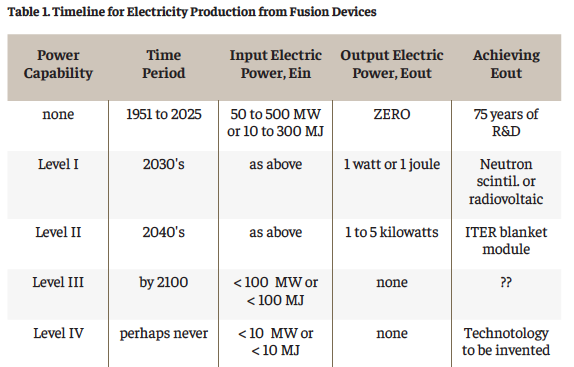
Timeline for Electricity Demonstration

Table 1 indicates a realistic timeline on which various levels of fusion-derived electricity, Eout, might eventually be demonstrated. These demonstrations comprise 4 stages, denoted Levels I, II, III and IV in the following discussion.

Level I. It’s conceivable that within the next 10 years some fusion device using a gimmick or stunt may be able to produce a few fusion-derived watts or joules of electricity (gross, not net). Self-powered neutron detectors can produce only milliwatts. Watt-level output may be possible using neutron-induced scintillations, directly or indirectly, and in any case demands a more capable fusion device than anything operating today (2025).

Level II. For a more meaningful power demonstration, my 2021 article [1] outlined how a few kilowatts of electrical output could be generated with a single blanket module on the ITER facility, presently scheduled to operate with D-T in the 2040’s. This demonstration would be equivalent to the powering of a few lightbulbs by Idaho’s EBR-1 in 1951 [2] The output could be increased by recruiting more blanket modules, but would always be insignificant compared with ITER’s staggering 300 MW of electric power drain during a pulse. 

In view of its turbulent history, there is substantial probability that ITER will never become operational with deuterium-tritium [3]; in that case even a kilowatt-level demonstration of fusion electricity will remain indefinitely far away.

Level III. The much greater challenge of producing net electric output from a fusion facility will be thwarted by the high power consumption of any fusion device and its support systems. That power drain combined with a structural inability to convert fusion product energy with high efficiency means that achieving net electric output (Eout = Ein) is likely impossible in the foreseeable future.

Level IV. Still more challenging, useful power generation (i.e., Eout :>> Ein) will not be attained until unknown and radical new technologies emerge for generating fusion reactions that do not require huge power consumption and are amenable to efficient energy conversion Such developments cannot presently be imagined and must await the next century or even later. 

Terrestrial Fusion Power is Apparently Unreachable

Today there is no fusion device anywhere in the world that could perform even a Level I demonstration. Yet fusion promoters claim that they are building power reactors that will perform at Level IV as soon as commissioned in the next decade.

When will journalists, investors and planners recognize and concede that they have been mislead and manipulated by fusion promoters in national labs and private companies? They cannot and will not. This situation has persisted for 75 years and unlikely to change. Within a decade there may be some kind of setback to the present fusion frenzy when no visible results will have been produced. However, by then the promised schedules for power plants will have receded into the 2040’s (the standard decadal shift), and a new population of credulous investors and government planners will have appeared. 

The following poem summarizes the status and prospects of fusion-generated electricity.

The Fusion Power Lament 

by Daniel Jassby

They can’t produce one watt electric gross,
Fusion labs and firms are mainly comatose.
The longest crusade in technology's history
Is the hapless quest for fusion electricity.

Each plasma pulse consumes multi-megajoules
That cannot be reduced despite all plans to retool.
Yet producing just one kilojoule of electric gross
Is unlikely unless observers can self-hypnose.

Minuscule rep. rate plagues ICF
And paltry neutron fluence rules MCF.
Fusion energy flux lies beneath contempt
Confounding any power-making attempt.

My tiny solar-powered calculator
Can generate one full watt electrical,
Their billion-dollar fusion reactor
Has output purely hypothetical.

To generate even one watt electric net
Needs performance that will never be met.
No matter its cost in billions of quid
Their fusion device will only drain the grid.

Despite zero electric output a fusion pretender
Devours more power than an AI data center.
A voracious consumer of coolant resources,
Uses more water than a hundred golf courses.

Because vital tritium fuel does not exist,
Myths about “breeding” it still persist.
Low burnup of tritium is the greater threat
Incurring tritium losses that cannot be offset.

No laboratory fusion device has ever bred
Even one gram of tritium in a blanket of lithium.
They have to spend millions to buy it instead
And fuel self-sufficiency is purely delirium.

First there were only government labs,
Then universities jumped right in,
Now a hundred firms are prone to brag
They’ll become the fusion power kingpin.

Every player proclaims there is surely no crisis
Though all are afflicted with acute Theranosis.
Despite 75 years of hubris and bluster
Demand for billions more is all they can muster.

Planned projects are test reactors, pilot plants,
Demos and other fantasies,
Whatever can secure the grants,
But all are based on fallacies.

Take back your fancy roadmap
That says fusion power will come soon,
Your plans will once again be scrap
And fusion dreams once more will swoon.

No fusion lab or firm can produce electricity,
No fusion power for the rest of this century.
Perhaps they’ll have better luck in the next
If novel techniques can relieve fusion’s hex.

References

[1] Daniel Jassby, “Fusion Frenzy— A Recurring Pandemic,” APS Forum on Physics & Society, Vol. 50, No. 4, October 2021. https://higherlogicdownload.s3.amazonaws.com/APS/a05ec1cf-2e34-4fb3-816e-ea1497930d75/UploadedImages/P_S_OCT21.pdf 

[2] Rick Michal, “Fifty years ago: Atomic reactor EBR-I produced first electricity,” ANS Nuclear News, Nov. 2001, p. 28.

[3] Daniel Clery, “Giant international fusion project is in big trouble,” Science, 3 July 2024. https://www.science.org/content/article/giant-international-fusion-project-big-trouble.

Top

Reviews

Nuclear Choices for the Twenty-First Century

Richard Wolfson and Ferenc Dalnoki-Veress. MIT Press, 2021. ISBN 9780262542036. $40

It has been decades since the thought of MAD crossed my mind. Not MAD magazine with Spy vs. Spy, but the Mutually Assured Destruction that kept us from using nuclear weapons. Wolfson and Dalnoki-Veress’s book tells the history and discusses the future of the nuclear industry. The book is divided into three large sections: The Nuclear Difference, Nuclear Power, and Nuclear Weapons. The book’s main goal is to inform citizens about nuclear issues, which the authors come right out and tell you are complex, but important to know about for our future. The questions about nuclear issues “raise technical, political, moral, and practical questions about nuclear issues. The answers we give and the choices we make have potentially major roles in shaping the future of civilization and of our planet itself.”

The book assumes no background in science; therefore, Section One, The Nuclear Difference, is the physics and chemistry needed to understand the discussions about nuclear power and weapons sections. The overall focus of the section compares the energy available when dealing with the nucleons (nuclear forces) compared to electrical forces (chemical reactions like burning coal). The section starts with the particles that make up the atom and the different categories of forces. Following chapters deal with radiation, radioactive decay, units of radiation, and where we encounter radiation in our life (background radiation). Chapter Four gets into the details of biological effects of radiation. As a physicist, a lot of the biological effects were new and interesting for me. This chapter also discusses the positive impact the use of radiation has had in the medical field. In the introduction to the book the authors state that they did not write the book to “give you all the answers,” but they do make statements of scientific consensus, such as daily radiation “is one of the lesser risks most of us face”. Section One ends with a chapter on fusion and fission along with a discussion on binding energy. All the chapters end with a nice focused summary.

Section Two, Nuclear Power, contained the most interesting chapters for me. In this section the authors set the stage then discuss our choices for generating electrical energy. 

This section starts with how we make electrical energy and uses a lot of figures and information from Wolfson’s Energy and Society. The following chapter covers nuclear energy, the types of reactors (with pros and cons) and what scientists are working on for future reactors. Of course, the book covers nuclear accidents. Three Mile Island, Chernobyl, and Fukushima are always interesting stories to read. The authors tie the amount of radiation released back into Section One, comparing it to background radiation. This section also covers what we are doing with nuclear waste, why it is dangerous, and what other countries are doing with their waste. The section ends with the dream of nuclear fusion. I was surprised to see that we have come much closer to achieving net energy gain after 70 years of work in this field. Just this week I read about a company in Massachusetts with a plan to build the first fusion power plant using the tokamaks scientists have been working with for decades. They have 2 billion in capital investment. Maybe I will see a fusion power plant in my lifetime. 

Section Three, Nuclear Weapons, is the difficult section to read, even more so with the present world events. The book was written in 2021. A lot has happened in the last 4 years. I wonder what the authors would have to say about Trump’s second term. They discuss many of his policies during the first term in this section. Section Three is the longest section, comprising almost half the book. Like the other sections, the authors look at the past, present, and future. The section has some classic figures/photos. It includes things you don’t read about in the 21st century such as the recommended response to a nuclear explosion. People still discuss what to do in the event of a nuclear attack. Such as dividing the blast area into zones, light, moderate, and severe damage zones, to help focus the of for first-responders. The authors don’t mention what that response should be. They also cover the yields and the effect of detonating bombs at different altitudes. I found out we made nuclear weapons where you can “dial-a-yield” before deploying, crazy! This section covered ALL the details of nuclear weapons; how they are constructed, the effects, different delivery methods, politics, terrorism, defense, and arms control. The authors spend a great deal of time on the dreams of a defense against a nuclear attack. They even cover things such as single-shot kill probability and acceptable “leakage”. They do conclude for us that a missile defense system is ineffective with these straightforward words, “our nation can be destroyed in half an hour, and there’s nothing we can do to prevent it.” This section by far has the most difficult questions to think about with the most devastating outcomes. I am of an age that I don’t wish to think about nuclear war – again. 

One of the strengths of the book is putting the history of nuclear issues into context with scientific facts. This is not a “I couldn’t put the book down” read. It is much easier to close the book and watch a fun movie than think about these difficult issues. Many chapters read like a science textbook; the authors cannot do anything about that but try to make it as accessible as possible for non-scientists. The book is an excellent historical snapshot of where we have been in terms of nuclear power and weapons. It weaves in the present state of US and world usage of nuclear power and who has the weapons, along with a discussion of the future options. Section two confirmed, for me, that using nuclear power for electric generation is a good transition away from fossil fuels. Section three established, for me, that yes, we still live in scary times. I will try not to get mad about it.


Dr. Jeff Williams
J7williams@bridgew.edu
Bridgewater State University


Top