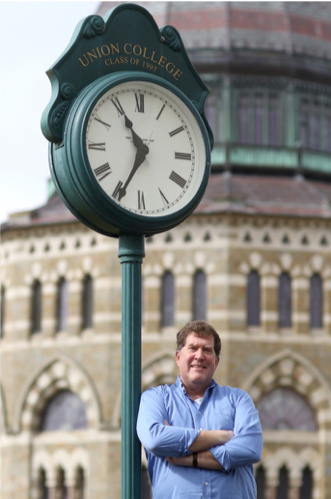
 Chad Orzel
Union College
"For informing the public about physics with an approachable and accessible style, through social media and the publication of popular books that provide insight into physics and science."
What was your most exciting experience while doing science?
One of the experiments I did as a grad student was on time-resolved collisions between ultra-cold xenon atoms, which was suggested by Phil Gould of the University of Connecticut. His group had just done a similar experiment, and while visiting the lab where I worked at NIST he said "You guys should try this, I bet it would work well with your system." I filed that away, and a few weeks later when I needed to do something really tedious to fix one of the lasers, I said "I don't feel like doing that, I'm going to spend this afternoon doing that experiment Phil suggested, instead." I figured it would be kind of a brief aside in my eventual thesis.
When I got it working, there was a second peak in the signal where I had expected only one, and it took a whole day to convince ourselves that it wasn't just a garbage effect. Once we realized the actual explanation (the expected peak was single ions, the second one ionized molecules), we realized that there was a TON of information we could extract from that signal, and it turned into its own full thesis chapter. The two post-docs on the project and I spent about three months on it all told, and every now and then, they would tease me about the start of the whole thing, saying "A one-afternoon experiment, huh?" It was the first project that I was really the lead on, and ended up as a first-author paper in Phys. Rev. Letters. The referee on the paper said the nicest thing I've ever seen in a referee report, along the lines of "The only argument I have with this paper is where the authors say there is a lot of further work to be done; I think this paper covers everything." That was a huge thrill.
How long have you been communicating physics and material science to the general public?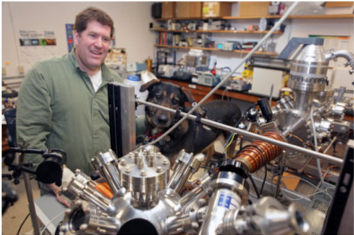
I got into reading the first generation of blogs back in 2000-2001, when I was a post-doc, and when I started at Union in the fall of 2001, I thought about starting one. Most of the blogs I was reading were just about politics, though, and I said, "I don't really have any relevant expertise here, and nobody needs just another guy spouting off opinions." Then I ran across Derek Lowe's original blog (he's still going, at In the Pipeline, now hosted by Science magazine) where he talked about pharmaceutical chemistry from the perspective of somebody working in the industry. That made me say "Ah-ha! I can write about physics, and being a professor..." and led to the start of my original blog, Uncertain Principles, in late June 2002. In Internet geological terms, this is after the asteroid killed off the dinosaurs, but close enough to it that the dust from it was still making colorful sunsets.
Your citation lists many different methods of communication. Do you have a favorite? Which method do you think is most effective overall? Which, if any, methods that are more effective for particular groups of the public?
All the different things I've done-- blogs, books, social media, public talks, the occasional tv appearance-- are fun, in different ways. I'm probably best suited to blogs and books, because writing prose has always come relatively easy to me. I also really enjoy giving live lectures, because there's a without-a-net quality to that that's a real kick. I struggle with Twitter because I'm badly phase-matched to it as a medium-- it rewards in-the-moment engagement, but the time of day when I'm most available to do social-media stuff is early in the morning when very few people are on Twitter, and the time when most Twitter users are active is in the evening, when I'm turning into a pumpkin. Video is also tricky-- I've made a few short videos myself to put on YouTube, but it's a very fussy business, and enormously time-consuming.
Probably the most impactful thing I did was writing a series of four videos on quantum physics for TED-Ed, which then were animated by professionals. Every now and then, I have reason to look one of them up on YouTube, and the number of views they've racked up is just astonishing. I think those get used in schools, so they've really reached a ton of young people. Video is extremely hard to do, but incredibly powerful when done right.
What was your most exciting experience communicating science?
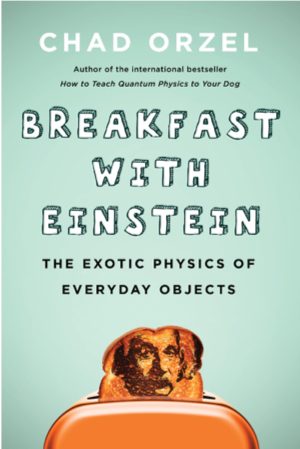
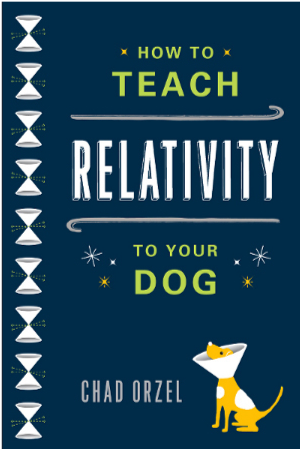
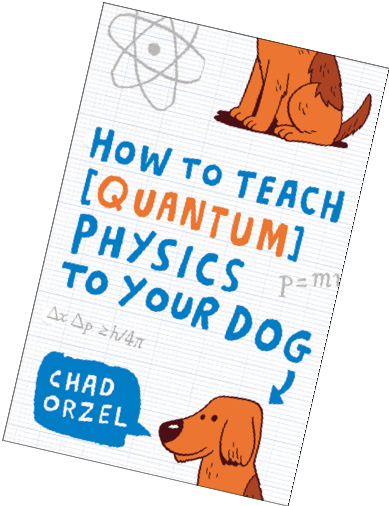
I've done a lot of fun individual events, but it's really hard to top the weird sequence of events that led to my first book. I had done a silly blog post where I talked to my dog about quantum electrodynamics in, I want to say, January of 2007, and that went over reasonably well. I went back to the talking-dog thing on a day in May of that year, with a post about the Many-Worlds interpretation, and that one got linked by Cory Doctorow at Boing Boing, and 50,000 people read it that weekend. A few days later, I got an email from a guy who said he was an agent, and would like to talk to me about doing something with that, and my initial reaction was "Ha, ha, that's funny," but then I googled his name, and discovered that this was legit-- there was a profile article about how he worked with an agency doing exactly this, finding people on the Web and connecting them with other opportunities. So I set up a call with him, then he put me in touch with a literary agent, and we were off.
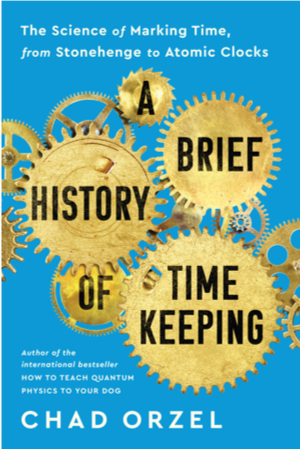
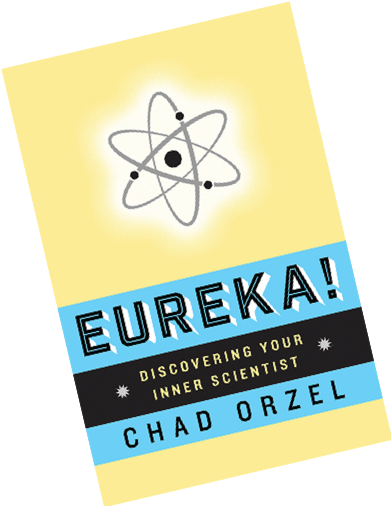
I didn't initially think the talking-dog thing had enough legs, as it were, to stretch out to make a whole book, but on reflection, it turned out to be more flexible than I expected-- we actually got two books out of it. And having done those set up the subsequent books, and now it's a whole career.
So, really, the most exciting moment was probably that realization that "Wait, this is really a thing that people are interested in!"
Why do you think your work sharing science to a broader audience is important?
As we've all learned the hard way over the last couple of years, many of the biggest challenges facing modern society have their roots in scientific issues-- pandemic disease and climate change chief among them. Understanding these issues, and weighing options for both personal action and public policy requires a certain degree of comfort and confidence in the institutions of science, but more importantly the PROCESS of science. I think science outreach, broadly defined, is essential for producing this, providing a way for people who don't think of themselves as scientists to get enough of a sense of the subject to have confidence that the process of science really does lead to an accurate and useful understanding of the world. If I can get a literature major to understand a bit of something as seemingly esoteric as quantum mechanics-- and, more importantly, how we came to know that it's real-- then that can help them look a little more favorably on scientific findings and recommendations that are a little closer to everyday experience.
And, you know, on a much less lofty level, this stuff is just REALLY COOL, and I enjoy sharing that with people.
Top